













Scientists Grow Bigger, Better Diamonds

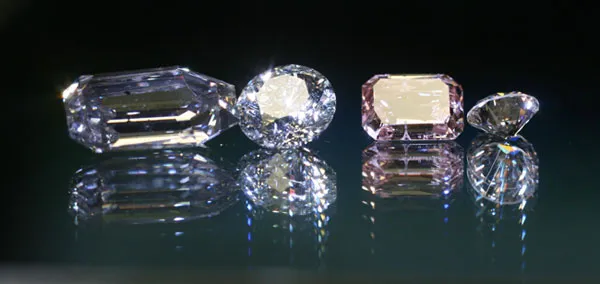
If you thought that rock on the ring in the window of Tiffany's was big and beautiful, the diamonds treated in labs with a newly-developed method will really blow you away.
Diamond, a particular form of pure carbon, is of course used for more than adding sparkle to jewelry. It is also used for making scalpel blades, electronic components, and even quantum computers.
But the very properties of diamond that make it perfect for these uses — its hardness (it's the hardest known naturally-occurring mineral), optical clarity and resistance to chemicals, radiation and electrical fields — can also make it a difficult substance to work with.
Defects can be purged from diamond by a heating process called annealing, but this process can turn diamond into graphite, another form, or allotrope, of carbon that is soft and gray and used in pencil leads.
To prevent graphitization, diamond treatments have previously required using high pressures (up to 60,000 times atmospheric pressure, or the pressure we experience at sea level) during the annealing process, but such high pressure/high temperature processes are expensive and put limits on the size and amounts of diamonds that can be treated.
A team of scientists at the Carnegie Institution in Washington, D.C., have found away to get around these issues — and make bigger, better diamonds.
Growing diamonds
Get the world’s most fascinating discoveries delivered straight to your inbox.
They use a method called chemical vapor deposition (CVD) to grow synthetic diamonds. Unlike other diamond-growing methods that use high pressures like those found deep in the Earth where natural diamonds are formed, CVD produces single-crystal diamonds at low pressure. These diamonds can be grown very rapidly and have relatively few defects.
The Carnegie team could take these synthetic diamonds and anneal them at temperatures up to 3,632 degrees Fahrenheit (2,000 degrees Celsius) at pressures below atmospheric pressure. The annealing process turns the diamond crystals, which are originally yellow-brown, colorless or light pink. The process also has minimal graphitization.
"It is striking to see brown CVD diamonds transformed by this cost-efficient method into clear, pink-tinted crystals," said study team member Chih-shiue Yan.
The researchers also figured out what causes the pink tint: A nitrogen atom takes the place of a carbon atom in certain place in the crystal structure. This finding "may also help the gem industry to distinguish natural from synthetic diamond," Yan said.
The new method, detailed in the Oct. 27 issue of the journal Proceedings of the National Academy of Sciences, also lets the researchers grow diamonds bigger. "The most exciting aspect of this new annealing process is the unlimited size of the crystals that can be treated," said study team member Ho-kwang Mao. "The breakthrough will allow us to push to kilocarat diamonds of high optical quality."
The Hope Diamond is a mere 45.52 carats.
- Wild Technologies: The Next Step With Richard Hart
- Diamond's Structural Secrets Revealed
- How Are Diamonds Made?

Andrea Thompson is an associate editor at Scientific American, where she covers sustainability, energy and the environment. Prior to that, she was a senior writer covering climate science at Climate Central and a reporter and editor at Live Science, where she primarily covered Earth science and the environment. She holds a graduate degree in science health and environmental reporting from New York University, as well as a bachelor of science and and masters of science in atmospheric chemistry from the Georgia Institute of Technology.