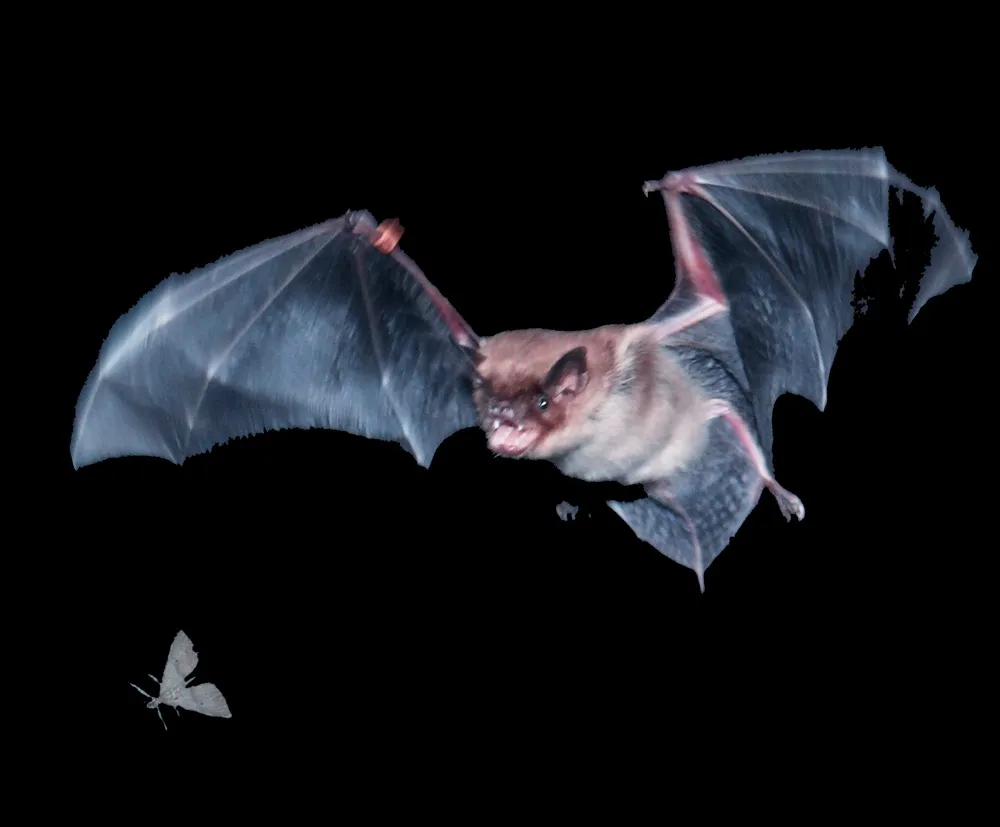
Bats can flutter, hover, dive-bomb and change directions midair with tremendous agility. They owe part of their incredible nocturnal navigation to echolocation, of course. But new research highlights another, underappreciated source of a bat's amazing abilities: the wing.
Bat wings sport a unique touch-receptor design, researchers report today (April 30) in the journal Cell Reports. Tiny sensory cells associated with fine hairs on the bat wing likely enable the animals to change the shape of their wings in a split second, granting them impressive midair maneuverability.
"The wing of the bat is really a very specialized structure," study researcher Cynthia Moss, a neuroscientist at Johns Hopkins University, told Live Science.
Not only do bats use their wings for flight, Moss said, but they also use them to capture prey and to cuddle their young. Appropriately, the scientific name for the scientific order that includes bats is Chiroptera, a word that means "hand-wing." [See Stunning Images of Bats in Flight]
A sense of touch
Moss and her colleagues first began examining the miniscule hairs on bat wings two years ago, recording how the absence of these hairs influenced flight. After rendering bat wings temporarily hairless with an over-the-counter depilatory cream, the researchers measured the bats' flight behaviors. The scientists found that without wing hair, bats did not slow as quickly when they approached objects. Their midair turns were also less tight. Neurological studies revealed that bat brain cells responded when the hairs were stimulated with air puffs or light touch.
Researchers found tiny sensory cells associated with fine hairs (shown here) on a bat's wings.
(Image credit: Johns Hopkins University)
To learn more, Moss and scientists in her lab teamed up with Columbia University biologist Ellen Lumpkin, who specializes in touch receptors. The scientists were able to identify sensory cells, called Merkel cells, which are dedicated to fine touch in the bat wing. These Merkel cells were closely associated with the fine hairs of the wing; some 47 percent of wing hairs had a Merkel cell next door to the follicle, the researchers found.
Sign up for the Live Science daily newsletter now
Get the world’s most fascinating discoveries delivered straight to your inbox.
The hairs "serve as a lever, and when they move, that activates the receptor," Moss said.
Other sensory cells, called lanceolate endings, were also found near hairs. Together, Moss said, these cells provide bats with immediate information about airflow over the wing.
Nimble neurons
By tracking the responses of bat brain cells, or neurons, to stimulation of these sensory cells, the researchers found that the neurons reacted with a burst of activity and then inactivity, even if the stimulation was long lasting. That suggests the sensory cells are adapted for speed, Moss said, as if they're saying, "OK, here's the information. Now do something."
The researchers also traced the path of nerves from the wing to the spinal cord, and discovered that bats are unusual among mammals. In most mammals, the hand or forelimb sends its signals to the cervical spine, in the neck, with a few nerves dipping down to the thoracic spine in the trunk. Bats, in contrast, have nerve pathways headed to both the neck and the trunk. The reason, Moss said, seems to be that part of the bat wing actually grows from trunk tissue during prenatal development.
All of this is important, Moss said, because it helps explain how bats — the only true flying mammals — have adapted their wings for flight and other daily needs. The findings might also inspire human engineering.
"There are potential applications for aerial vehicles to become more maneuverable, drawing on some of the biological principles that are illustrated in the bat," Moss said.
Stephanie Pappas is a contributing writer for Live Science, covering topics ranging from geoscience to archaeology to the human brain and behavior. She was previously a senior writer for Live Science but is now a freelancer based in Denver, Colorado, and regularly contributes to Scientific American and The Monitor, the monthly magazine of the American Psychological Association. Stephanie received a bachelor's degree in psychology from the University of South Carolina and a graduate certificate in science communication from the University of California, Santa Cruz.