













Tiny Sea Monkeys Create Giant Ocean Currents

Every evening, sunset signals the start of dinner for billions of wiggling sea monkeys living in the ocean. As these sea monkeys — which are not actually monkeys but a type of shrimp — swarm to the surface in one large, culminating force, they may contribute as much power to ocean currents as the wind and tides do, a new study reports.
Even though they're small, sea monkeys — given the playful name because their tail resembles a monkey's tail, but also known as brine shrimp (Artemia salina) — may contribute about a trillion watts, or a terawatt, of power to the surrounding ocean, churning the seas with the same power as the tides, the researchers said. A terawatt can light roughly 10 billion 100-watt light bulbs.
Most people recognize sea monkeys as popular pets for children and aquarium enthusiasts. Dehydrated sea-monkey eggs are easily shipped and spring to life once they're placed in saltwater. Devotees can watch a group of brine shrimp hatch, grow and mate within weeks.
In the wild, brine shrimp migrate upward to the ocean's surface at twilight to feed on microscopic algae. At sunrise, they swim downward, away from menacing predators such as fish and birds. [Watch Sea Monkeys Create Powerful Underwater Currents – Video.]
A few brine shrimp swimming up and down don't have much influence on the ocean patterns. But together, multitudes of these tiny creatures generate strong currents that may affect the circulation patterns of oceans around the globe, the researchers found.
To get a better sense of the brine shrimps' collective power, researchers examined them in a special aquarium equipped with lasers. (Brine shrimp tend to swim toward light, so using lasers would be a great way to herd them, the researchers reasoned.)
A blue laser that rose from the bottom to the top of the tank triggered upward migration. At the same time, a green laser in the middle of the tank kept the brine shrimp centered in a group, similar to how they stick together in the ocean.
Get the world’s most fascinating discoveries delivered straight to your inbox.
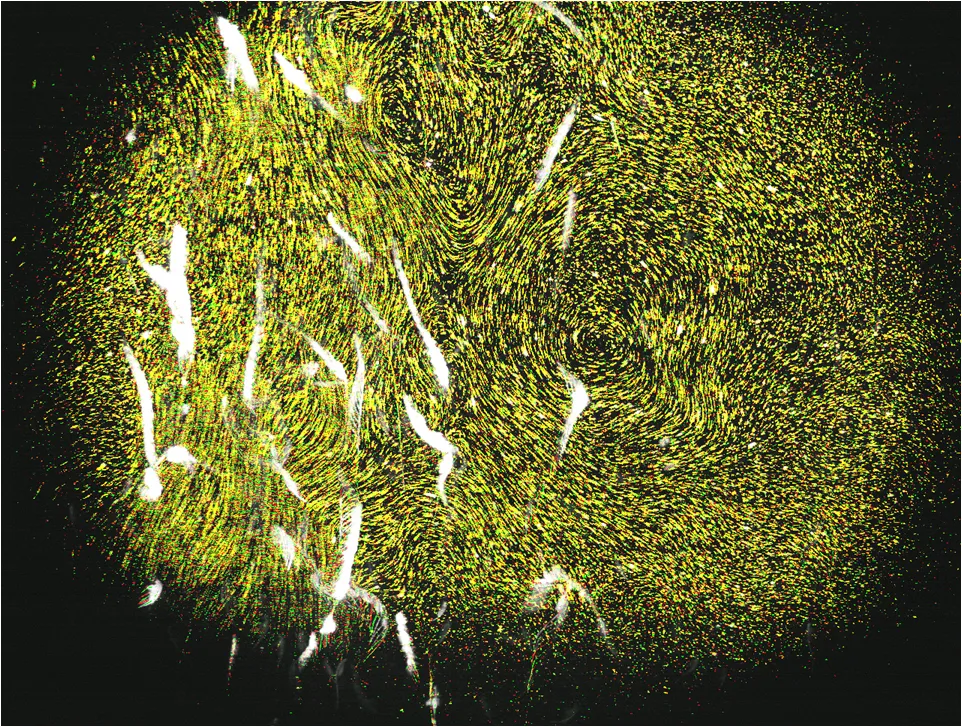
The shrimp were small — just 0.2 inches (5 millimeters) long — but that didn't stop the researchers from measuring the swarm's communal current. The team poured microscopic, silver-coated glass beads into the water and, with the help of a high-speed camera, recorded the changing direction of the water.
Each sea monkey has 11 pairs of legs that double as paddles. When two or more of these creatures swim side by side, eddies they create interact with larger currents, which could change the ocean's circulation, the researchers said.
"This research suggests a remarkable and previously unobserved two-way coupling between the biology and the physics of the ocean," study researcher John Dabiri, a professor of aeronautics and bioengineering at the California Institute of Technology, said in a statement. "The organisms in the ocean appear to have the capacity to influence their environment by their collective swimming."
Usually, researchers credit the wind and tides for creating currents that mix the ocean's salt, nutrients and heat. In contrast, this study suggests that microscopic animals also influence currents. In a study published in 2009 in the journal Nature, Dabiri and his colleagues proposed that sea creatures such as jellyfish mix ocean waters, and ventured that even smaller organisms could do the same. This study offers evidence for their idea, at least in an aquarium environment.
In the future, the researchers plan to use a tank with increased water density at the bottom, which imitates real-life ocean conditions. "If similar phenomena occur in the real ocean, it will mean that the biomass in the ocean can redistribute heat, salinity and nutrients," Dabiri said.
The study was published online today (Sept. 30) in the journal Physics of Fluids.
Follow Laura Geggel on Twitter @LauraGeggel and Google+. Follow Live Science @livescience, Facebook & Google+. Original article on Live Science.

Laura is the managing editor at Live Science. She also runs the archaeology section and the Life's Little Mysteries series. Her work has appeared in The New York Times, Scholastic, Popular Science and Spectrum, a site on autism research. She has won multiple awards from the Society of Professional Journalists and the Washington Newspaper Publishers Association for her reporting at a weekly newspaper near Seattle. Laura holds a bachelor's degree in English literature and psychology from Washington University in St. Louis and a master's degree in science writing from NYU.