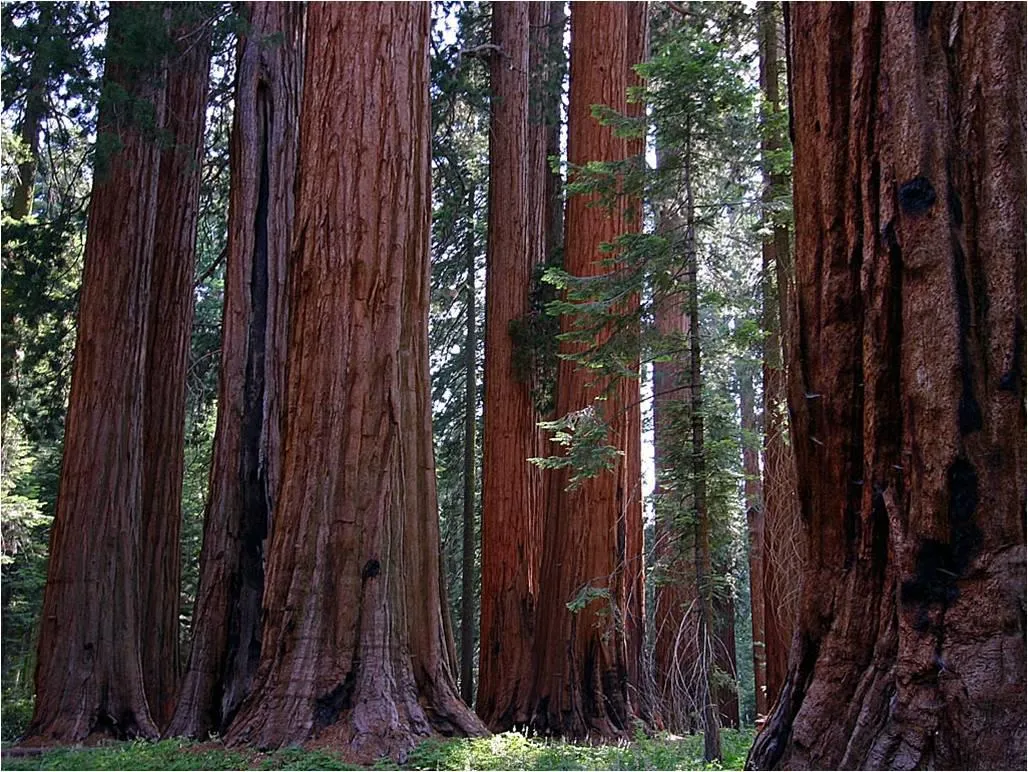
SACRAMENTO, Calif. — California's iconic trees, the giant sequoias, may sail through the state's current extreme drought. The huge trees survived even drier conditions during their long lives, studies show. The oldest sequoias live for more than 3,000 years.
But will giant sequoias still be around as California's climate shifts under the influence of global warming? It's hard to know — there are still too many unsolved mysteries about these massive trees, many scientists say. Even during California's last serious drought, in the 1970s, giant sequoias started growing faster, though no one is sure what is driving the gains. But climate models forecast even warmer and drier conditions by 2100 for California, which could make the sequoias' mountain soil too parched for the world's biggest trees. To better understand how to protect and preserve giant sequoias, scientists are looking at how sequoias live today, and where they lived in the past.
"We're particularly concerned about the giant sequoias, because they're really dependent on the snow melt in the Sierras," said Anthony Ambrose, a research scientist at the University of California, Berkeley (UCB). [Nature's Giants: Photos of the Tallest Trees on Earth]
Since the 1950s, the Sierra Nevada snowpack has shrunk by nearly 15 percent. With less winter snow, which sequoias rely on for much of their summer water supply, both trees and their seedlings may suffer during long, dry summers. (The Sierra Nevada mountains are the only place in the world where sequoias are found.)
The President Tree, an enormous 3,240-year-old tree in Sequoia National Park, slurps 2,831 liters (748 gallons) of water every day during its growing season, according to research presented here at the Ecological Society of America's annual meeting Aug. 11 through Aug. 14. [All Yours: The 10 Least Visited National Parks (Photos)]
(Image credit: National Geographic)
All that water supplies the mighty tree's huge amount of wood and almost 2 billion leaves. The leaves alone weigh in at just over 2 tons (1,831 kilograms), Ambrose said. "That's just mind-boggling," he said.
Sign up for the Live Science daily newsletter now
Get the world’s most fascinating discoveries delivered straight to your inbox.
Ambrose and his colleagues climb sequoias and their cinnamon-colored cousins, the coast redwood, measuring how the trees change from bottom to top. The study is part of the 10-year Redwoods and Climate Change Initiative, funded by the Save the Redwoods League in San Francisco.
From their preliminary results, they found the leaves at the tops of these tall trees seem different than those at the bottom. (The tallest sequoias top out at more than 250 feet (76 meters), and some fallen trees are even longer.) The lofty leaves seem more resistant to tension from water pressure — from the tree working to pull water from its roots — and they have different levels of carbon and oxygen than lower leaves, the researchers reported at the meeting. Measuring these elements can reveal more information about how sequoias use water, Ambrose said.
At the root level, sequoias influence the surrounding soil, researchers have discovered. On the downhill side of the trees, where more leaves and branches pile up, the pH is higher compared to soil beneath nearby sugar pines, Stephen Hart, an ecologist at the University of California, Merced, reported at the meeting. Hart and his students tested soils in Yosemite National Park's sequoia groves and found more nitrogen, calcium, magnesium and phosphorous in the soils near sequoias. "The fertility of the entire soil is enhanced," Hart said.
Withstanding drought
A drought could also be hard for seedlings and young trees, which don't have well-developed root systems that can tap water supplies.
But giant sequoia seedlings seem to have an effective drought response — they completely shut down tiny pores in their leaves, called stomata. Closing their stomata blocks water loss, but it also means the plants can't photosynthesize. Instead, "they live on storage water," explained lead researcher Stefania Mambelli, a plant ecophysiologist at UCB. Mambelli and her colleagues have raised giant sequoia and coast redwood seedlings in a nursery and shut off water to the plants for six weeks to mimic drought conditions.
(Image credit: Linda & Dr. Dick Buscher)
Scientists are also concerned that climate change could bring a new danger to the giant sequoias via diseases. "It doesn't take moisture stress alone to kill a tree," said Koren Nydick, an ecologist at the Sequoia and Kings Canyon National Parks. Sequoias are normally resistant to most diseases that plague California's forests. But a giant sequoia planted by John Muir in the San Francisco Bay 85 years ago, outside its natural range, is now dying of a fungal disease, Nydick said. And coast redwoods are not only carriers for sudden oak death, they are also four times more susceptible to fire damage because of the fungus, which has killed tens of thousands of California oaks, according to a study published in October 2013 in the journal Ecology.
Sequoias alive today have survived droughts. But a 1992 U.S. Forest Service study, of ancient pollen from a mountain meadow in Sequoia National Park, suggests there were fewer giant sequoias 4,500 years ago when the California climate was drier.
"That leads us to ask if they were near extinction," Nydick said. "Despite their resistance and their huge storage capacity, there is a threshold. Are we going to reach that?"
Becky Oskin covers Earth science, climate change and space, as well as general science topics. Becky was a science reporter at Live Science and The Pasadena Star-News; she has freelanced for New Scientist and the American Institute of Physics. She earned a master's degree in geology from Caltech, a bachelor's degree from Washington State University, and a graduate certificate in science writing from the University of California, Santa Cruz.