















A peatland in the Amazon stopped absorbing carbon. What does it mean?
Peatlands cover just a fraction of Earth's surface, but store huge amounts of carbon. In the Peruvian Amazon, one of these swamps has switched to carbon neutral.


A palm swamp peatland in the Peruvian Amazon that normally absorbs more carbon than it releases each year has switched to being carbon neutral, even with no major disturbance by local people.
On their face, the findings, reported June 30 in the journal Geophysical Research Letters, may seem like a sign of trouble. However, experts say there's more to the story.
Peatlands play a crucial role in the carbon cycle by absorbing carbon dioxide. In Peru, they cover some 22,000 square miles (56,000 square kilometers) — less than 5% of the country's total area. Yet they store about 5 gigatons of carbon belowground — roughly equivalent to all of the carbon stored aboveground in vegetation in Peru.
It's a similar picture globally, where, according to the International Union for Conservation of Nature, peatlands cover about 3% of the world's land area but store at least 550 gigatons of carbon — more than twice the carbon stored in all the world's forests.
"Peatlands represent such a small land area on Earth, but they are massively important as stocks of carbon," Jeffrey Wood, a biometeorologist at the University of Missouri and lead author of the new study, told Live Science. "These systems have accumulated gigatons of carbon over tens of thousands of years."
So what has happened in Peru?
Key ecosystems
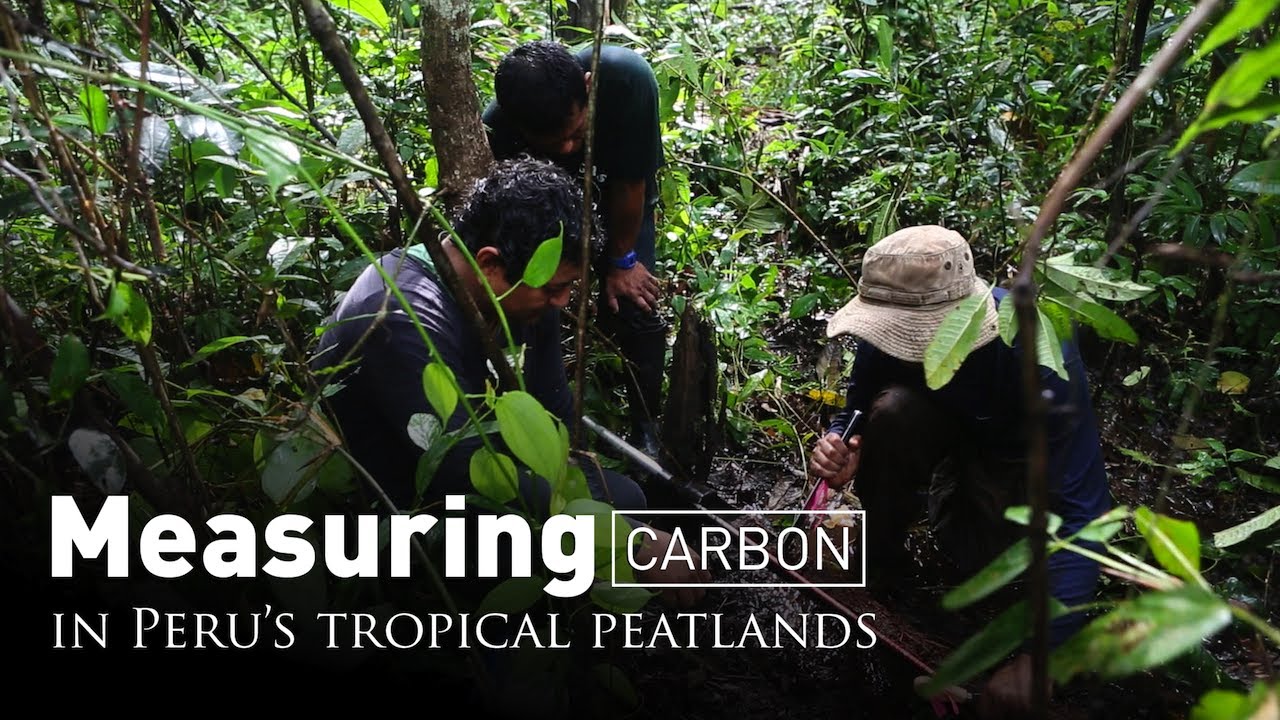
Wood and his colleagues have been studying the dominant kind of Amazonian peatland in Peru's Quistococha Forest Reserve. These swampy ecosystems, known locally as aguajales, are dominated by moriche palms (Mauritia flexuosa).
Get the world’s most fascinating discoveries delivered straight to your inbox.
These key ecosystems develop in areas that flood seasonally, with the palms providing a fruit called aguaje for locals, as well as for macaws, monkeys, tapirs and agoutis. These areas are densely vegetated havens for many birds, reptiles and mammals.
Crucially, the plants that grow there absorb carbon dioxide (CO2) from the atmosphere through photosynthesis. But because the area is waterlogged, their dead leaves and other fallen matter usually accumulate as peat in the low-oxygen environment, which traps carbon instead of fully decomposing and releasing it back into the atmosphere.
Wood and his colleagues found that the peatland switched from being a strong carbon sink in 2018 and 2019 to being about carbon neutral in 2022.
Yet there were no obvious signs of human effects on the ecosystem, Wood said. "The peatland hadn't been drained and the trees hadn't all been cut down or taken down by a storm," he said. "It also wasn't a major drought year or a major heat wave."

The swampy ecosystems studied are dominated by moriche palms.
Instead, the researchers found that two factors led to the change. The first is that prolonged cloudless periods and higher sun intensities limited the photosynthesis of the plants, thus restricting their growth and how much carbon dioxide they absorbed.
The second was that lower water levels left more of the top of the peat exposed. This meant more oxygen was available to bacteria in the decaying matter, which decomposed faster, releasing more carbon dioxide and methane gases than usual.
Lydia Cole, a conservation ecologist at the University of St Andrews in Scotland who wasn't involved with the work, told Live Science that normally, in the course of a year, a peat ecosystem goes through periods of greater carbon uptake and time of greater carbon release, but on average, the result is usually a net absorption of carbon.
"Across one landscape, you'll have areas that are releasing carbon and areas that are sinks, and peatlands often have a microtopography," she explained. "So it might be that on a mound you'll get more decomposition and emissions of carbon and in hollows, which are wetter, you'll get sequestration. But the net over the course of a year is what we're really interested in."
At first it seemed counterintuitive to Wood that more sunlight would cause less photosynthesis. But it could happen because the Quistococha rainforest is generally covered in thick clouds, he said.
"The plants are being exposed to much more light than they can deal with," Wood told Live Science. When there is too much light and heat, the plants close the pores, called stomata, on their leaves, through which they take in CO2 and release oxygen during photosynthesis.
That's why photosynthesis is often lower at midday in rainforests, and Wood and his colleagues saw that standard pattern in Peru. But what had changed was what happened in the normally very productive mornings and afternoons, where photosynthesis dropped below normal levels in the higher light intensities.
One big question is whether the peatland will return to being a carbon sink, stay carbon neutral, or progress to releasing huge volumes of its stored carbon.
Wood is optimistic that the peatland will regain its sink capacity in future years.
Chris Evans, a peatland biogeochemist at the UK Centre for Ecology & Hydrology in Wales who wasn't involved in the work, also advised against drawing conclusions based on one year. "I would expect a natural peatland to fluctuate between net sinks and neutral from year to year depending on weather conditions, particular[ly] if water levels get drawn down," Evans told Live Science. "I certainly would not interpret this as evidence of a long-term change in the carbon balance."
Human impacts
However, the change observed by Wood and his colleagues happened in the absence of an obvious human disturbance — but that doesn't mean humans haven't affected the sink or won't in the future.
"One ecosystem is not functioning as an island," Cole said. There are areas of grasslands and settlements in the wider region, which were created after deforestation. This could have changed local weather patterns, which then feed into longer-term climate changes, she said.
It's uncertain how climate change will influence tropical peatland in Peru or elsewhere in the Amazon, but any effects on cloud cover or changes in the water table are likely to affect the strength of these carbon sinks, Wood said.
Jean Ometto, head of the Centre for Earth System Science at Brazil's National Space Research Institute, who wasn't involved in the work, told Live Science that water table variation is a major issue in the Amazon generally.
RELATED STORIES
"In the Brazilian Amazon, we're facing extremes of floods and extremes of drought," he said. "The water table coming down can be a long-term process because of the frequent droughts. With the change in climate, that might be a permanent process, which is a huge problem."
The findings should be taken seriously but be put into perspective, Cole said. "We need to not cry wolf about this," she said. "But we also need to think really seriously about how we protect peatlands that remain healthy and how we can re-wet those peatlands that still have the capacity to sequester carbon into the future."

Chris Simms is a freelance journalist who previously worked at New Scientist for more than 10 years, in roles including chief subeditor and assistant news editor. He was also a senior subeditor at Nature and has a degree in zoology from Queen Mary University of London. In recent years, he has written numerous articles for New Scientist and in 2018 was shortlisted for Best Newcomer at the Association of British Science Writers awards.
You must confirm your public display name before commenting
Please logout and then login again, you will then be prompted to enter your display name.