













New Stick Insect Species Discovered in China

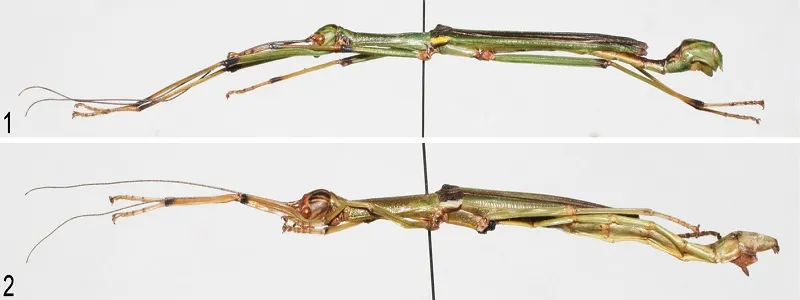
A stick insect camouflaged in the forests of southern China got its cover blown last month by a flashlight-toting scientist who identified the critter as a new species.
Like most stick insects, the new species Sinophasma damingshanensis has a long, narrow body and a green-brown coloration that allows it to blend in perfectly among plant stems. But insect hunters have a trick for spotting the disguised creatures.
"If you know the insects' food plant, you can find the corresponding species," George Ho Wai-Chun, a researcher from the Hong Kong Entomological Society, said in a statement. In this case, the insects were feeding on trees and shrubs in the Fagaceae or beech family.
Ho discovered S. damingshanensis on a collection trip in Damingshan Nature Reserve in south China's Guangxi province, an area that is home to many different kinds of stick insects. The evergreen forest is relatively undisturbed and explains why new species are still being discovered there.
Stick insects not only look like their surroundings, but sometimes they also rock back and forth to mimic the motion of plants in the wind. These masters of disguise are also nocturnal, making them even more challenging to find. To ensure that they go unnoticed by any passing predators, during the day they remain relatively motionless among the stems and leaves.
Ho used a flashlight to spot the new species on the leaves of Fagaceae trees at night, when the insects are more active. After examining the bugs more closely, Ho realized he had collected a new species. Most of the male insects are about 2 inches (5 centimeters) long while the females are closer to 3 inches (7 cm).
About 3,000 stick insects species have been discovered so far. They are part of the animal order Phasmida, which is the Greek word for "apparition." Twenty-six species belong to the Sinophasma genus; of those, 25 are native to China and one is found in Vietnam.
Get the world’s most fascinating discoveries delivered straight to your inbox.
The new discovery is detailed in the journal Deutsche Entomologische Zeitschrift.
Follow Kelly Dickerson on Twitter. Follow us @livescience, Facebook & Google+. Original article on Live Science.
