













Sperm-Inspired Robots Could Aid In Vitro Fertilization

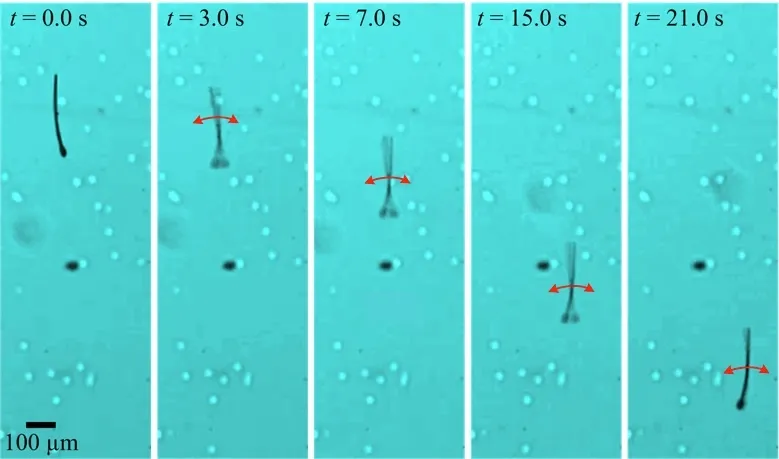
Just when you thought you'd seen every kind of robot there is, researchers develop bots inspired by sperm.
The tiny robots mimic the shape and movement of sperm cells and can be steered using magnetic fields. Dubbed "MagnetoSperm," the robots could be useful for administering medicine or carrying out in vitro fertilization, researchers say.
"Nature has designed efficient tools for locomotion at micro scales," study leader Sarthak Misra, a mechanical engineer at the University of Twente in the Netherlands, said in a statement. [The 6 Strangest Robots Ever Created]
Improvements in technology are making many products smaller, but it is difficult to assemble objects on the nanoscale (a billionth of a meter) or microscale (a millionth of a meter), the researchers said.
Misra and a team of scientists at his university and the German University in Cairo design robots inspired by nature or ones that use living microorganisms, such as magnetically propelled bacteria and sperm cells, for performing complex tasks on small scales.
In a new study, published today (June 2) in the journal Applied Physics Letters, the researchers created 322 1-micron-long (about 10 times the width of a human hair) robots with heads thickly coated with cobalt-nickel, but uncoated tails.
When the sperm bots were exposed to an oscillating magnetic field with a strength less than that of a refrigerator magnet, the force caused the sperm bots' heads to rotate and their tails to move back and forth, pushing the bots forward. The researchers steered the robots by aiming the magnetic field toward a reference point.
Get the world’s most fascinating discoveries delivered straight to your inbox.
The magnetic swimmers could be used for a number of biomedical applications, including drug administration, in vitro fertilization and the cleaning of clogged arteries, the researchers said.
The robots were assembled by a method known as spin coating, in which a thin polymer film is deposited onto a silicon wafer. The researchers chose a polymer that was simple to fabricate and wouldn't break down easily. They then used an electron beam to deposit the cobalt-nickel layer onto the heads of the bots.
The researchers plan to scale down their robots to an even smaller size and develop a magnetic nanofiber that could be used for the tails.
Follow Tanya Lewis on Twitter and Google+. Follow us @livescience, Facebook & Google+. Original article on Live Science.
