













Korean Mummy Holds Clues to Disease
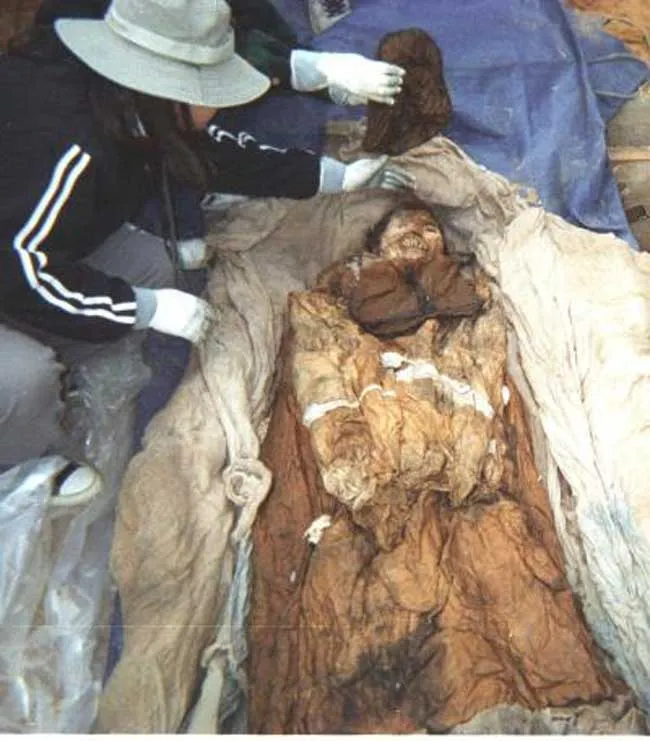
The liver of a child mummy preserved for 500 years still holds samples of the hepatitis B virus.
The mummy, along with others recently unearthed in South Korea, will help scientists understand how the virus evolved to its present state and what to expect in the future.
"This is a 'know your enemy' expedition to see if we can get information that can help today's—and tomorrow’s—sufferers," said Mark Spigelman of the Kuvin Center for the Study of Infectious and Tropical Diseases at the Hebrew University of Jerusalem. Spigelman is a paleo-epidemiologist, who studies ancient diseases found on mummified bodies to shed light on the modern forms of such illnesses.
This is the first time hepatitis B has been spotted in a mummified body.
In South Korea, 12 percent of the population are hepatitis carriers, more than double the world average. The virus, responsible for about 1 million deaths each year, spreads through contact with an infected person's body fluids, such as blood and semen. The body typically recovers from the infection on its own after a few months, but chronic infections can last a lifetime and cause scarring of the liver, liver cancer or failure.
Until recently, scientists didn't think mummies existed in South Korea. A building boom in the country has led to the relocation of many cemeteries and the discovery of mummies.
Mummification, which prevents the body from decaying naturally, would seem to go against Koreans' ancient tradition of ancestor worship and the belief that upon death the soul rises up and the body returns to its natural components. However, in 1392, a group called the Neo-Confucianists took over, revising former burial practices.
Get the world’s most fascinating discoveries delivered straight to your inbox.
The newer burial practice favored mummification. It involved laying the body on ice for up to 30 days and then placing the body inside a pine coffin buried in a lime soil mixture. Compounds have been found in pine with anti-fungal and anti-bacterial properties that likely put the brakes on decay of the bodies.
"In some cases, this inadvertently resulted in extremely good natural mummification," Spigelman said.
Spigelman is now part of an international team, including experts from the Liver Unit at Hadassah University Hospital-Ein Kerem in Jerusalem, Dankook University, Seoul National University and University College London. The researchers will compare the genome of the 500-year-old virus with today's hepatitis B to see how it evolved over the centuries.
Jeanna Bryner is managing editor of Scientific American. Previously she was editor in chief of Live Science and, prior to that, an editor at Scholastic's Science World magazine. Bryner has an English degree from Salisbury University, a master's degree in biogeochemistry and environmental sciences from the University of Maryland and a graduate science journalism degree from New York University. She has worked as a biologist in Florida, where she monitored wetlands and did field surveys for endangered species, including the gorgeous Florida Scrub Jay. She also received an ocean sciences journalism fellowship from the Woods Hole Oceanographic Institution. She is a firm believer that science is for everyone and that just about everything can be viewed through the lens of science.