













Unique Crystals: Newfound Purple-Pink Mineral Is Like No Other
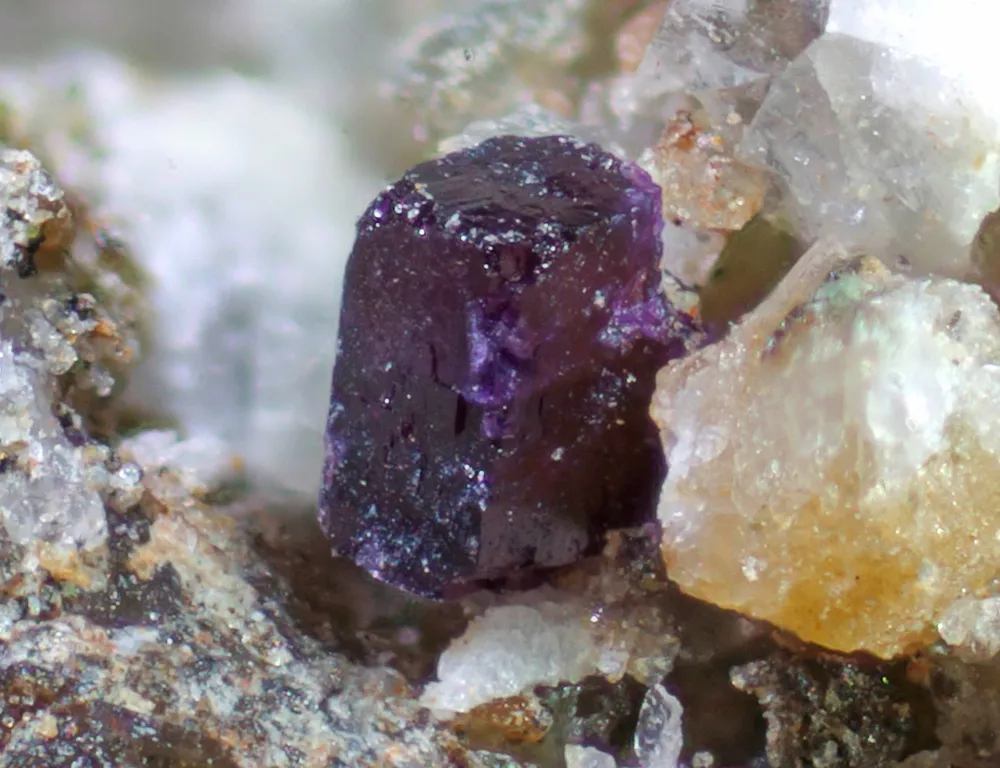
A new purple-pink mineral that has a chemical composition and crystalline structure unlike any of the known 4,000 minerals has been discovered at a mining site in Western Australia, researchers report.
Now called putnisite, the mineral was discovered in a surface outcrop of Polar Bear Peninsula, Southern Lake Cowan, north of Norseman. While workers with a mining company were prospecting for nickel and gold, one of them noticed the bright-pink grains and sent the mineral to the Commonwealth Scientific and Industrial Research Organization (CSIRO), and then it was sent to Peter Elliott, a research associate with the South Australian Museum, for examination.
And, sure enough, the crystal was novel.
"A mineral is different from currently known minerals if it has either a different chemical composition or it has a different crystal structure, or sometimes both," Elliott told Live Science in an email. "Occasionally, a new mineral will have a chemistry that is very different to other minerals, or it will have a crystal structure that is very different to other minerals." [See Stunning Photos of 'Godzilla' & Other Minerals]
Elliott added, "Putnisite, a strontium calcium chromium sulfate carbonate, has both a unique chemical composition and a unique crystal structure." (The color of putnisite crystals ranges from pale to dark purple, with a pink streak, according to the researchers.)
Found on volcanic rock, the new mineral occurs as tiny crystals just 0.02 inches (0.5 millimeters) in diameter, and looks like spots of dark pink on dark-green-and-white rock; under a microscope, the mineral appears as cubelike crystals.
"When the rocks in the Lake Cowan area were deposited millions of years ago, they contained small concentrations of strontium calcium chromium and sulfur," Elliott said. "Over time, weathering released these elements and concentrated them, allowing putnisite to crystallize."
Get the world’s most fascinating discoveries delivered straight to your inbox.
Though it is not uncommon to find a new mineral — 50 to 100 such specimens have been discovered in each of the past several years — they aren't usually discovered by miners, Elliott said.
"Often, they are found in museum mineral collections," he said. "Many new minerals are found by mineral collectors who will forward a specimen they have found to a mineralogist at a museum of [a] university for identification."
The researchers are not sure if the mineral, described in Mineralogy Magazine, has any practical uses. Putnisite gets its name from Australian mineralogists Andrew and Christine Putnis.
Follow Jeanna Bryner on Twitter and Google+. Follow us @livescience, Facebook & Google+. Original article on Live Science.
Jeanna Bryner is managing editor of Scientific American. Previously she was editor in chief of Live Science and, prior to that, an editor at Scholastic's Science World magazine. Bryner has an English degree from Salisbury University, a master's degree in biogeochemistry and environmental sciences from the University of Maryland and a graduate science journalism degree from New York University. She has worked as a biologist in Florida, where she monitored wetlands and did field surveys for endangered species, including the gorgeous Florida Scrub Jay. She also received an ocean sciences journalism fellowship from the Woods Hole Oceanographic Institution. She is a firm believer that science is for everyone and that just about everything can be viewed through the lens of science.