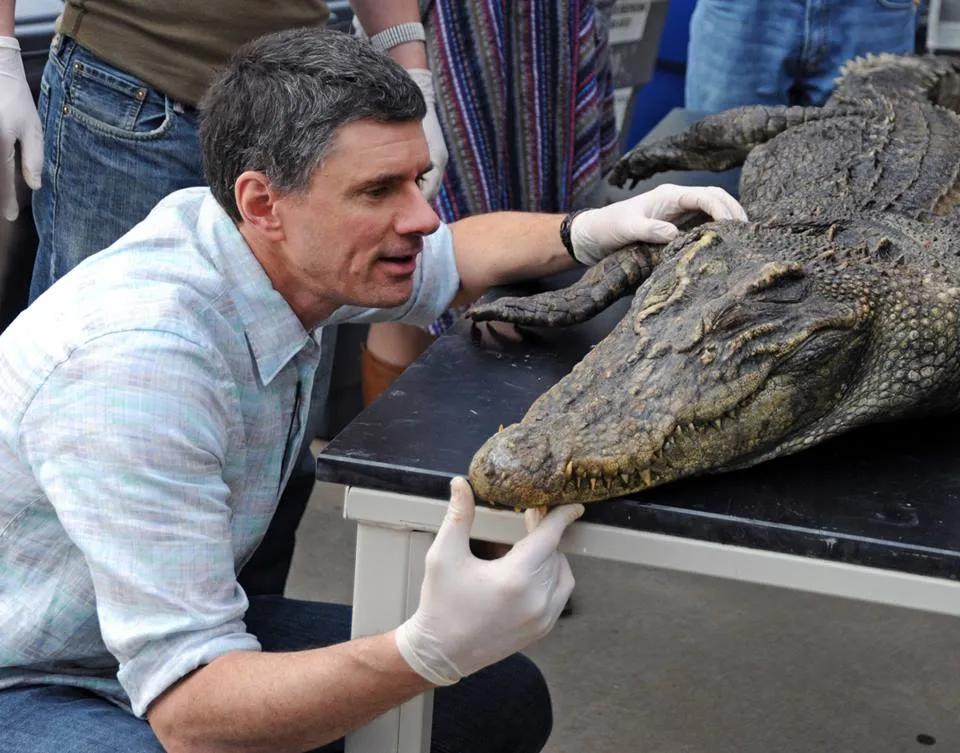
Larry Witmer of Ohio University says his team has probably scanned half of all modern-day crocodilian species. This specimen, a Siamese crocodile, was scanned on March 29, 2014.
For the past 15 years, anatomist Larry Witmer has been going through the back door of the O'Bleness Hospital in Athens, Ohio, pushing coolers stuffed with dead animals into the CT scanning room. He has brought in ostriches, slain rhinoceroses and rare kiwis. Last week, Witmer arrived with an 8.5-foot-long (2.6 meters) Siamese crocodile.
Witmer has dozens, sometimes hundreds, of animals in his freezer at Ohio University at any given time. He chose his car (a Ford Edge) based on its capacity to fit his unusual cargo. ("My wife is very forgiving," he says.) He primarily studies the evolution of organs in the skulls of dinosaurs, but unfortunately the fossil record doesn't give him much to work with — just the bones and teeth, not muscles, nerves, brain tissue or skin.
"As a biologist, I want to understand how they worked as living, breathing creatures," Witmer told Live Science. The closest approximation of preserved dinosaur soft tissue comes from dinosaurs' closest extant cousins: birds and crocodilians. That's why Witmer recently jumped on the chance to study a rare Siamese crocodile, thought to be in its 30s, that died of natural causes last year at a park called Alligator Adventure in North Myrtle Beach, S.C. [See Photos of the Frozen Croc's Trip to the Hospital]
The CT scan of the Siamese crocodile produced more than 8,000 cross-sectional slices just 300 microns (less than 0.012 inches) thick.
(Image credit: Ohio University)
Researchers at Marshall University collected the croc and shipped it off to Witmer and his team in December last year. On Saturday (March 29), the group finally put the frozen carcass through the CT (computed tomography) scanner at O'Bleness Hospital. They produced more than 8,000 cross-sectional X-ray images, each thinner than a hair, that fit together in a 3D model like the slices in a loaf of bread. Witmer said his results could be the most complete CT scan of any croc.
This precise level of detail allows scientists to see delicate features that relate to animals' senses, like smell and touch. Researchers can also view tiny canals in the inner ear that affect balance and that span just a couple of millimeters across. By observing these miniscule features in their natural positions, Witmer and his colleagues can attempt to piece together a more complete picture of how the elusive structures worked in dinosaurs.
To fit the frozen croc on the scanning table, researchers had to thaw the carcass, tuck its limbs in — mimicking the animal's natural swimming posture — and freeze it again.
(Image credit: Ohio University)
Saturday's scans even revealed rocks in the crocodile's stomach. The animals' famously sharp teeth are good for grabbing and ripping, but not chewing. Swallowed stones churning in the stomach help crocs grind up food. A dissection planned for next month should reveal this particular beast's last meal (as well as its sex).
Besides shedding light on the inner workings of extinct animals, the scanning also creates a record of a critically endangered species.
Sign up for the Live Science daily newsletter now
Get the world’s most fascinating discoveries delivered straight to your inbox.
"It presents a unique opportunity to actually capture, in a sense, an archive of the anatomy of this rare animal from the tip of the nose to the tip of the tail," Witmer said.
Siamese crocodiles aren't faring so well in the wild. By 1992, they were virtually extinct, and though conservationists don't have solid estimates on the species' numbers today, there may be as few as 250 individuals left in Southeast Asia.
At times, a feeling of sadness accompanies the arrival of a specimen like this croc, Witmer said. His lab takes in animals that couldn't be rehabilitated at wildlife sanctuaries, or rare creatures like rhinoceroses that fell prey to poachers. But, ultimately, Witmer sees his work as immortalizing these deceased creatures.
"We try to do it all with a sense of respect for these animals," Witmer said.
After Witmer and his team finish looking at the croc, they will send it back to South Carolina to be skeletonized in a surprisingly low-tech fashion: The body will be dried out and placed in a bug colony of flesh-eating beetles, who will lick the bones clean in a matter of weeks.
As Witmer and his colleagues continue to study the Siamese crocodile, they'll post updates and pictures on the lab's Facebook page. Eventually, computer users will be able to explore interactive visualizations of the crocodile on the lab's website.
Megan has been writing for Live Science and Space.com since 2012. Her interests range from archaeology to space exploration, and she has a bachelor's degree in English and art history from New York University. Megan spent two years as a reporter on the national desk at NewsCore. She has watched dinosaur auctions, witnessed rocket launches, licked ancient pottery sherds in Cyprus and flown in zero gravity. Follow her on Twitter and Google+.