













New Fingerprint Technique Tracks Total Weasels
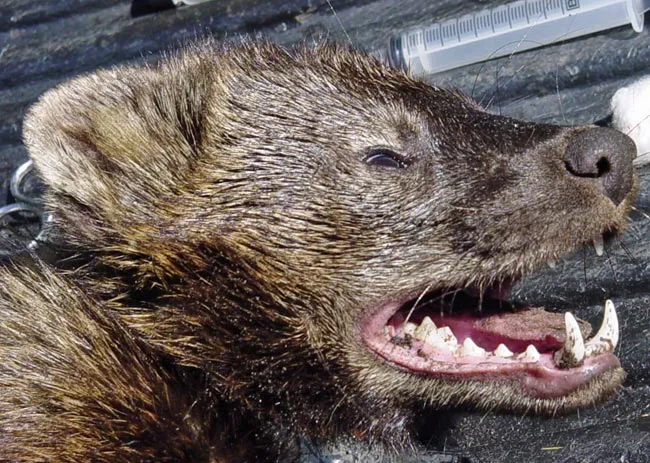
Fishers are weasels—quite literally—and are the only carnivores known to tote unique fingerprints. Exploiting this little-known fact, New York conservationists are catching the elusive animals red-handed to estimate their numbers in the wild.
Unlike apes and koalas, which have curves and ridges on their digits, eight-pound fisher weasels carry patterns of dots on the pad of each paw. However, as researchers report in this month’s issue of the Journal of Wildlife Management, human fingerprint recognition software couldn’t match their prints.
“We tried submitting fisher prints to the state’s fingerprint database but it didn't pair up the prints well,” said Richard Higgins, retired chief of the New York State Department of Criminal Justice’s Bureau of Criminal Identification. He thought the technique might work because the software is highly specific for patterns, but the old-fashioned matching method triumphed: Simply “looking at them side-by-side it was obvious when you had a match,” Higgins said.
Higgins and conservationists at the New York State Museum put their heads together to develop a new technique to match prints: By measuring the spacing between just 10 of more than 1,000 dots on each print, according to the study, fishers can be reliably identified 99.997 percent of the time.
The scientists said the method is far simpler and less expensive compared to alternative tracking technologies, such as DNA fingerprinting or camera traps. All that’s required, in fact, is a box, adhesive paper, bait and time to analyze the prints.
To gather “crime scene” evidence of fishers, researchers went to the Adirondacks of New York and set up modest print traps. After a few days, they returned to find the prints of curious fishers.
The conservationists are eventually looking to apply the forensic technique to track animals less well-off than the fisher, which has made a dramatic comeback after being decimated by trappers through the 1930s.
Get the world’s most fascinating discoveries delivered straight to your inbox.
“Identifying individuals allows us to actually count how many animals are in different areas, which is essential information for monitoring their conservation status,” said Justina Ray, director of Wildlife Conservation Society Canada. “My hope is that we can apply this kind of inexpensive, sure-fire technology to help conserve a wide range of species.”