















Crows Solve Puzzles Inspired by Aesop's Fables

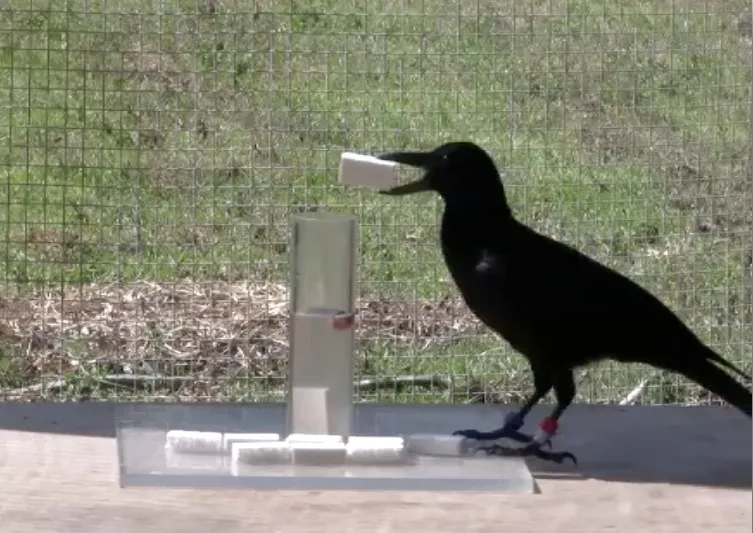
Crows are famously clever creatures — so much so that the birds' intelligence was recognized in ancient lore. In the story of "The Crow and the Pitcher" from Aesop's Fables, a thirsty crow drops stones into narrow jar to raise the low level of water inside so he can take a drink.
Now scientists have evidence to back up that tale. New Caledonian crows actually do understand how to make water displacement work to their advantage, experiments showed. The results suggest that the birds are, at least in some respects, as smart as first-graders, according to the study.
Researchers, led by Sarah Jelbert at the University of Auckland in New Zealand, presented six crows with tubes filled with water. Inside the tubes, a worm or chunk of meat on a cork was floating, just out of reach of the crow's beak. [The 5 Smartest Non-Primates on the Planet]
In front of the tubes, the researchers arranged a bunch of heavy rubber erasers that would sink, and light polystyrene objects that would float. In other variations of the experiment, the birds were presented with hollow and solid cubes.
The crows figured out that they could drop the heavy objects and the solid cubes into the tubes in order to raise the water level and get their snack, the researchers reported March 26 in the journal PLOS ONE.
The crows' understanding of water displacement, however, might be incomplete. The birds fumbled in experiments in which they could choose to drop objects in either a wide tube or a narrow tube to retrieve a snack, the researchers said. Dropping objects into the skinnier tube would lift the water level by a greater amount and put the treat within reach after just two drops. In contrast, it took around seven drops to raise the snack to the same level in the wider tube. The crows apparently didn't realize this, and most of them went for the wider tube first.
Previous studies showed that chimpanzees and human children can solve similar tasks. In a 2011 study detailed in PLOS ONE, apes and kids figured out that they could spit water into a tube to reach a peanut that was floating in a small amount of water at the bottom.
Get the world’s most fascinating discoveries delivered straight to your inbox.
"The ability to detect and respond to relevant causal properties demonstrated here, is striking — in spite of its limits — and rivals that of 5- to 7-year-old children," the researchers of the new study wrote.
The results only add to the list of crows' amazing abilities. The birds are known to use tools, making hooks out of sticks to fish ants out of nests. They don't forget a face, and they hold grudges against humans they perceive as threatening.
Editor's note: This article was updated on Dec. 27 2014 to correctly state that the University of Aukland is in New Zealand (not Australia as the article originally stated). Live Science regrets the error.
Follow Megan Gannon on Twitter and Google+. Follow us @livescience, Facebook & Google+. Original article on Live Science.
