













Hong Kong to Destroy More Than 30 Tons of Ivory

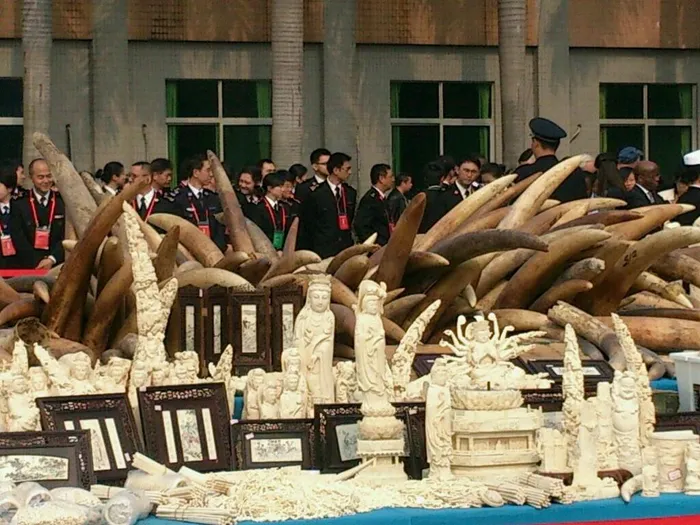
Following in the footsteps of China and the United States, conservation officials in Hong Kong announced that they will destroy their stockpile of confiscated ivory.
Hong Kong will start burning more than 30 tons (28 tonnes) of elephant tusks and other ivory products in the first half of 2014, but the disposal of the massive hoard might not be complete for another two years, officials said last week in a video of the announcement released by the non-profit group WildAid.
The ivory trade was banned in 1989 by the Convention on International Trade in Endangered Species of Wild Fauna and Flora (CITES). And yet, a large black market for ivory still thrives, fueling elephant poaching in Africa. The Wildlife Conservation Society (WCS) has estimated that some 96 elephants are killed each day on average, mostly for their ivory.
As Hong Kong is a major transit point for ivory headed to China, conservation groups lauded the decision.
"Destroying stockpiles helps with efforts to combat the trade in illicit ivory because all too often in some countries, the ivory leaks out of stockpiles and re-enters the trade," Simon Hedges, WCS's ivory trade policy analyst, said in a statement, adding that "destroying stockpiles removes the need to spend a fortune keeping the ivory under lock and key."
The African Wildlife Foundation's CEO Patrick Bergin also said that by incinerating its stockpile, Hong Kong will raise awareness that owning ivory "has a dark side, one that is connected to wholesale elephant slaughter, civil unrest, terrorism and a complex supply network of criminals and corrupted officials."
Earlier this month, China burned some of its own confiscated ivory in a public ceremony. The United States also destroyed the illegal ivory it has recovered over the past 25 years, pulverizing 6 tons (5.4 tonnes) of it with a stone crusher in November 2013.
Get the world’s most fascinating discoveries delivered straight to your inbox.
Follow Megan Gannon on Twitter and Google+. Follow us @livescience, Facebook & Google+. Original article on Live Science.
