














Go West, Young Raven: Clever Birds Use Power Lines to Spread to New Territory

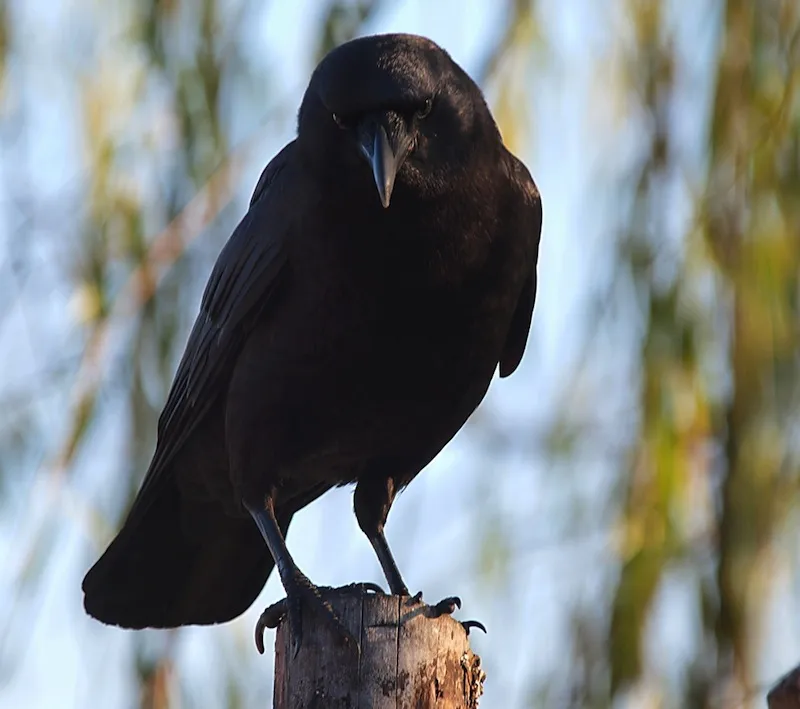
Ravens are using power lines to colonize new territories in the western United States, new research finds.
And although living on live electric lines is dangerous, ravens seem to fare unusually well.
"Maybe they are smart enough to know not to touch a particular line?" study researcher Kristy Howe, a graduate student at Idaho State University, told BBC News.
Whether brains or some other factor keep ravens safe, their high roosts on power poles are a danger to other species, Howe and her colleagues reported in January in the journal The Condor: Ornithological Applications. Ravens prey on the eggs and young of the ground-dwelling greater sage grouse as well as those of the endangered desert tortoise, the endangered San Clemente loggerhead shrike and the California least tern. Their vantage point from their power-pole nests makes air attacks easier.
The study found that a whopping 58 percent of raven nests on U.S. Department of Energy land in southeastern Idaho were perched on power poles. Another 14 percent were on other human structures, and just 19 percent were in trees. The proliferation of human structures in the sagebrush ecosystem might explain why raven populations have increased more than 300 percent over the last four decades, the researchers explained.
Follow Stephanie Pappas on Twitter and Google+. Follow us @livescience, Facebook & Google+.
Get the world’s most fascinating discoveries delivered straight to your inbox.

Stephanie Pappas is a contributing writer for Live Science, covering topics ranging from geoscience to archaeology to the human brain and behavior. She was previously a senior writer for Live Science but is now a freelancer based in Denver, Colorado, and regularly contributes to Scientific American and The Monitor, the monthly magazine of the American Psychological Association. Stephanie received a bachelor's degree in psychology from the University of South Carolina and a graduate certificate in science communication from the University of California, Santa Cruz.