















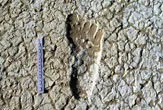
About 20,000 years ago, humans trekked along the margins of a shallow lake in Australia, leaving behind records of their passage in the soft, wet sand.
In 2003, an aboriginal woman who is likely a descendant of those early Australians stumbled across dozens of timeworn footprints in the same area. Excavations of the site have since uncovered hundreds more.
The discovery, detailed in a recent issue of the Journal of Human Evolution, represents the largest collection of Pleistocene human footprints in the world, and the only footprints from that era ever found in Australia. In total, 457 footprints have now been uncovered.
"The preservation is just remarkable," said study team member Matthew Cupper of the University of Melbourne in Australia. "You can see quite clearly how mud oozes between the toes."
The Pleistocene stretched from about 2 million to 12,000 years ago. Highlights from the era:
- A series of climatic upheavals, the worldwide spread of human-like primates, or hominids;
- The extinction of Neanderthals and large land mammals—including mammoths, giant sloth and saber toothed cats;
- The rise of modern humans.
Ancient errands
The footprints were found in southeastern Australia, along the shore of one of 19 dried up lakes that comprise the Willandra Lakes system.
Get the world’s most fascinating discoveries delivered straight to your inbox.
The researchers believe the prints were made over a series of weeks or months about 20,000 years ago when the site was exposed. Males and females, ranging from children to adults, are represented, and many of them seem to be doing different things.
"Quite a few people seem to be running and heading the same way," Cupper told LiveScience. "Some of the little children were walking slower. This may suggest that there were several events represented."
Australia is thought to have first been colonized by humans about 50,000 years ago. Those who made the newfound footprints were likely the ancestors of today's Australian aborigines, the researchers say.
Then and now ...
Like most of modern Australia, the area where the tracks were found is today dry and desert-like. Yellow-white sand dunes shift across the landscape, blown by arid winds, and little rain falls.
"It's not the most attractive landscape today, but back during the last Ice Age, there was substantial [water] drainage off the Eastern Australian highlands," Cupper said. "It would have been large freshwater expanses filled with fish and crustaceans that could support a human population."
Humans weren't the only ones that passed through the area. The prints from two kangaroo hind paws are visible, as are the tracks of a baby emu, a large flightless bird similar to an ostrich. Cupper says the emu prints might be an important clue about when the human footprints were made.
"This emu is between 50 and 70 days old, so it's just a small chick," he said. "Emu's generally nest in the winter time, so it could reveal that the site was exposed in the season of spring or early summer."