













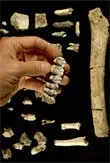
Newfound fossils from Ethiopia are giving scientists a clearer glimpse into the murky origins of a hominid species that was an important link in the evolution of ape to man.
The 4-million-year-old fossils belong to Australopithecus anamensis, the earliest known member of Australopithecus, the genus right before our own, Homo.
The new bones—which include a femur, several teeth and the largest jaw fragment ever recovered from any hominid—were discovered last December in the Middle Awash valley of Ethiopia, a region well-known for its rich deposit of hominid fossils.
All together now
The fossils were found sandwiched between sediment layers containing the fossils of an earlier species, Ardipithecus ramidus, and the geologically younger Australopithecus afarensis.
| Ape to Man |
The story of human evolution can be divided into three distinct phases, beginning with our split from the common ancestor we shared with chimpanzees 8 million to 6 million years ago. |
- The oldest genus is Ardipithecus, of which Ar. ramidus was the last member.
- Australopithecus came next. This genus began with Au. anamensis and includes Au. afarensis, of “Lucy” fame.
- Lastly is Homo, the genus containing Homo erectus, Neanderthal, the “Hobbit,” and us—Homo sapiens.
This is the first time these three species have been found together in one geographic location and in such a tight chronological order, scientists say.
The finding is detailed in the March 13 issue of the journal Nature.
Get the world’s most fascinating discoveries delivered straight to your inbox.
Filling in the gaps
The Middle Awash valley of Ethiopia has the longest and most continuous record of human evolution of any place on Earth.
Scientists have found the fossils of nearly 250 hominid specimens embedded within more than a mile of stacked sediments representing time periods that stretch back 6 million years.
The fossils of Ar. ramidus, Au. anamensis and Au. afarensis follow on the heels of one another in Middle Awash’s sediment layers—appearing at roughly 4.4 million, 4.2 million and 3.6 million years ago, respectively—allowing scientists to accurately pinpoint the time when Australopithecus first appeared.
“The origins of Australopithecus have always been tricky, but now we have enough fossil evidence to indicate that the first occurrence of Australopithecus occurred 4.2 million years ago,” study team member Yohannes Haile-Selassie, head of physical anthropology at the Cleveland Museum of Natural History, said in a telephone interview.
A, B, C
Since their remains don’t overlap, scientists think the three species are directly related, evolving one from the other, rather than being cousins that shared a common ancestor.
“This discovery fills the gap between Ardipithicus and Australopithecus,” said study team member Tim White, an anthropologist at the University of California, Berkeley.
“Here is one place on Earth where you have 12 separate [sediment layers], one stacked on top of another, whose fossils have filled in many of the gaps in human evolution over the years,” White told LiveScience. “Many of the links are no longer missing.”
- Evolution: How it Works
- Oldest Walking Human Ancestor Said Found
- Hundreds of Human Genes Still Evolving
- Researcher: Early Man Was Hunted by Birds
- Prehuman Remains Found in Ethiopia
- The Top 10 Missing Links