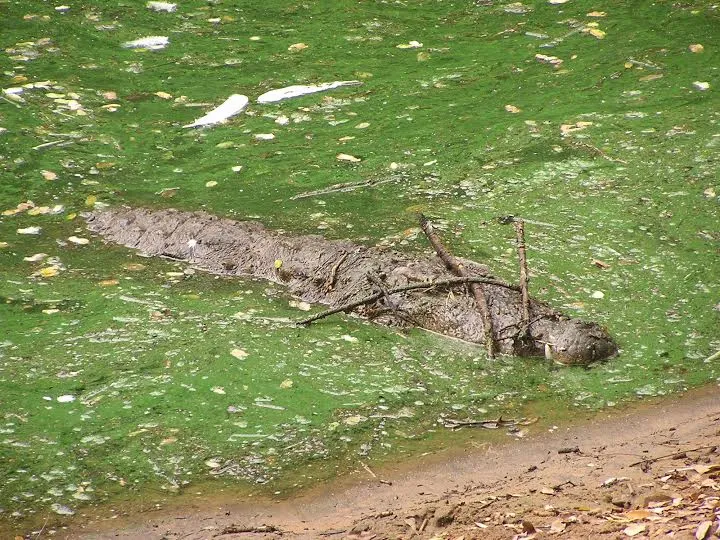
It's official: Reptiles can use tools to help them hunt.
New research shows that alligators and crocodiles can use small sticks to attract birds looking for nesting materials. If the birds get too close, they become a meal. The behavior has so far been observed among American alligators in Louisiana, as well as mugger crocodiles (also known as marsh crocodiles) in India.
Alligators only engaged in this trickery during the nesting season and in areas where birds nested, said Vladimir Dinets, a behavioral ecologist at the University of Tennessee Knoxville. During nesting season, there's often a shortage of sticks in marshy areas where these reptiles and birds overlap, and birds sometimes even fight amongst themselves to procure sticks to build nests. The study, which Dinets co-authored and which was published in late November in the journal Ethology Ecology & Evolution, suggests that there is no other explanation for this behavior than as one of tool use.
"What's really remarkable — they are not only using lures, but they are timing it to just when the birds they want to capture are nesting and looking for sticks to use," said Gordon Burghardt, an ethologist (animal behaviorist) and comparative psychologist specializing in reptiles at UT-Knoxville. "They are making some assessment of the birds themselves."
An American alligator successfully lures a snowy egret with a stick, and then eats it, at St. Augustine Alligator Farm Zoological Park in Florida.
The finding, along with other recent work, suggests reptiles are much more intelligent than generally acknowledged, Dinets said. As anybody who studies the beasts can attest, they are quite smart, he added. Crocodiles, for example, have complex communication systems, can hunt in coordination and ambush prey, and both parents may help raise young, he said.
Relatively less is known about crocodiles and alligators than many animals, because, as large predators, they are difficult to raise in the lab and study up close in the wild. Their cold-bloodedness also makes them slow.
Sign up for the Live Science daily newsletter now
Get the world’s most fascinating discoveries delivered straight to your inbox.
"They operate on a different time scale; they do things more slowly," Burghardt said. "Sometimes we don't have the patience to let them strut their stuff, as it were … so this kind of study is important."
Wading birds like snowy egrets have been known to nest in wooded islands near areas with high levels of alligators, for example in Florida. Scientists think the birds nest near such scaly enemies because the alligators keep at bay predators like snakes. Apparently, the occasional loss of adult birds to the hungry alligators, or nestlings that fall into the water, is worth the lowered risk of being eaten by something else, according to the study.
Douglas Main loves the weird and wonderful world of science, digging into amazing Planet Earth discoveries and wacky animal findings (from marsupials mating themselves to death to zombie worms to tear-drinking butterflies) for Live Science. Follow Doug on Google+.