













Connectivity is Key to Understanding the Brain

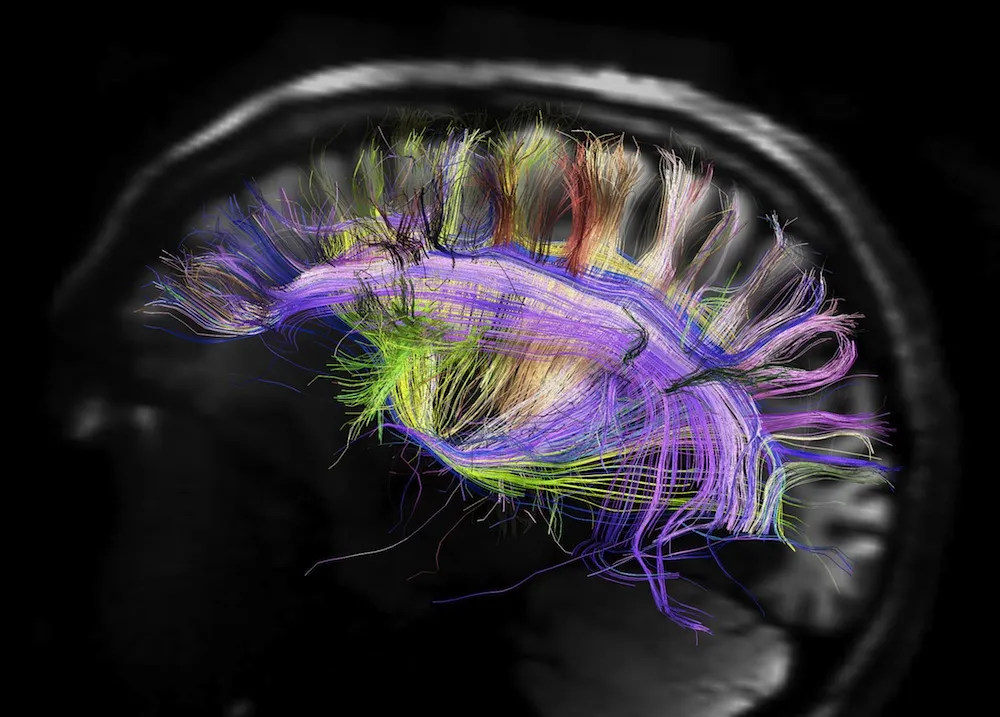
The human brain is a marvel of neural wiring, from links between individual neurons to fibers that meander through vast brain regions.
Efforts to understand the brain's wiring are loosely grouped under the term the "connectome." Interest in the connectome has flourished in recent years, said neuroscientist Henry Kennedy of the Stem-Cell and Brain Research Institute in France. He is also the author of one of the articles published as part of a series on brain wiring in the journal Science today (Oct. 31).
Social networks
"There's a recognition that understanding neural processes involves understanding the underlying structure," Kennedy told LiveScience. [Top 10 Mysteries of the Mind]
Until recently, the prevailing view of brain connectivity has been the so-called "Small World" model. In human society, this model says that social groups are highly connected, and that any two people are only about six "handshakes," or acquaintances, away from knowing each other. When translated to the brain, this view considers only whether or not two brain regions are connected, not the strength or distance of the connection.
By contrast, Kennedy and his colleagues now show the human brain to be a densely connected network, where about 70 percent of the brain is connected to every other area. In the social group analogy, the brain is more like a tribal society, in which everyone knows everyone else, but some people (such as the chief) are more influential than others.
Using a new database of cortical connectivity — connections in the brain's outermost layer, where complex thought occurs — the researchers found that the strength of the connection between two areas decreased with their distance from each other.
Get the world’s most fascinating discoveries delivered straight to your inbox.
The new understanding of how different brain regions interconnect hints at how the brain is wired down to the level of single neurons, Kennedy said.
Structure versus function
But the wiring of the brain isn't the whole story. The brain is a dynamic organ, and it’s the dynamic patterns of activity that give rise to the richness and diversity of human cognition. [Inside the Brain: A Photo Journey Through Time]
To unravel the mystery of brain function, scientists employ both theoretical approaches and experiments, often using brain imaging.
In particular, functional magnetic resonance imaging (fMRI) has played a major role in cognitive neuroscience. The technique is widely available, and it allows scientists to study the brain noninvasively.
The general approach, said neuroscientist Nicholas Turk-Browne of Princeton University, is to try to identify hot spots of activation in the brain where the activity seems to be related to some ongoing process, such as recognizing faces.
"We've made a lot of progress with that approach, and yet there are many aspects of brain function that aren't accounted for," Turk-Browne, who wrote another of the Science articles, told LiveScience.
The article explains that brain functions are distributed across different brain areas, not confined to a single region. Any complex behavior requires interactions between these areas.
What's more, these interactions depend on a person's "cognitive state," such as whether he is thinking about what he had for breakfast or listening to an opera, Turk-Browne said.
Studying the brain in its seemingly infinite complexity is tricky, and will require scientists to rely on tools from computer science, he said.
The use of fMRI is a powerful technique for probing the brain. But by definition, the method detects metabolic activity of brain areas, not neuronal firing itself. The two are correlated, but there's a significant time lag between neuron activity and when areas light up in the brain scans.
How brains learn
Finally, scientists can learn a lot about the brain from learning itself. One aspect of brain function that most studies miss is the differences in how different brains learn, and the brain changes that result.
"We're starting to realize, if you look at the initial state of the brain prior to learning, we can predict the way the brain is going to change in the context of learning," said neuroscientist Robert Zatorre of McGill University, in Canada.
Zatorre authored an article exploring the question of whether speech and musical abilities are embedded in the brain structure or can be learned and modified.
"We don't know whether these abilities are states or traits," Zatorre told LiveScience. (States are conditions that only exist right now, whereas traits are things that have existed a long time, perhaps from birth.) "I think there's evidence for both explanations."
By combining studies of the brain's connectivity between different regions and ultimately, individual neurons, with theoretical models and physiological studies of brain function, neuroscientists are beginning to piece together the puzzle of the human mind — a puzzle that is far from complete.
Follow Tanya Lewis on Twitter and Google+. Follow us @livescience, Facebook & Google+. Original article on LiveScience.
