













New Skin Lets Robots Get Sensitive
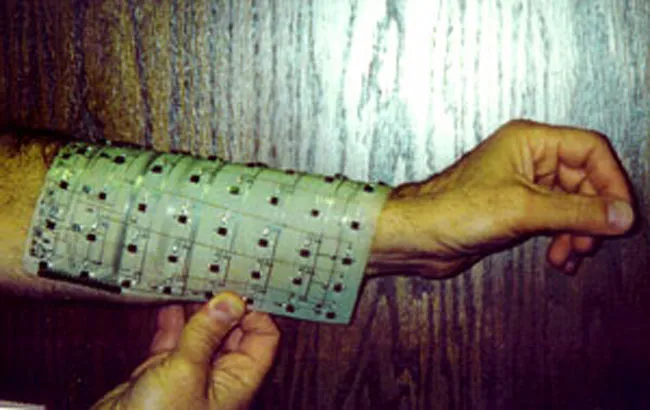
Scientists are working on a type of skin that will allow robots to be more touchy feely.?
The high-tech skin has fingernail sized sensors embedded all over its surface. The sensors allow a robot to "feel" changes in its surroundings and move accordingly.
"Robots move well on their own, especially when nothing is in the way," NASA technologist Vladimir Lumelsky said. However, trouble arises when something gets in a robot's way. "Robots should be able to react, but today's robots can't."
Lumelsky's new skin for robots is a flexible plastic covering that includes more than 1,000 infrared sensors. The sensors detect an object and relay the signal to the robot's "brain." The brain processes the information and applies reasoning within milliseconds, allowing the robot to react and move.
In the laboratory, the skin allows a robot arm to gracefully accompany a ballerina and perform simple tasks without disrupting a pair of people playing chess.
Future editions of the skin will likely have even more sensors, providing greater dexterity to the robots.
One hurdle for the technology will be producing it in large, wallpaper sized sheets and embedding it on a large surface material. NASA intends to use the skin in space, so it must also pass rigorous environmental tests such as extreme changes in light, temperature, and radiation.
Get the world’s most fascinating discoveries delivered straight to your inbox.
Lumelsky holds strong that tactile sensation is a critical necessity for robots, particularly those with unstructured tasks. While computer vision has become quite advanced in recent years, there is no substitute for reaching out and feeling something.
Tactile technology will be more and more necessary in the future, when robots and people will likely work side by side. It will be important for the robots to be able to sense where the humans are in relation to themselves in order to prevent accidents or injuries.
To view short videos of a robot arm dancing with a ballerina or avoiding people, click here.