














Can watching a solar eclipse really make you go blind?
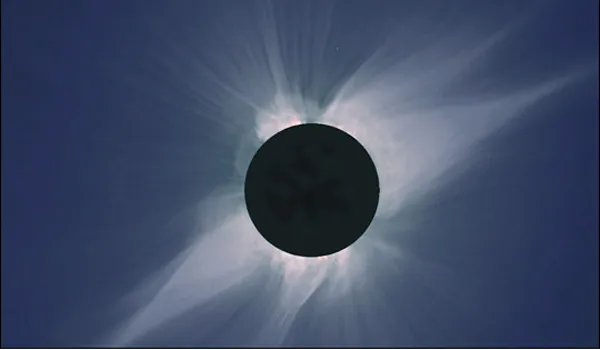
If you live in Europe, Asia or Africa, you have a good seat for watching today's solar eclipse, the first of four partial solar eclipses slated to occur in 2011. Just make sure you heed the advice of eye experts don't stare directly at the event. And definitely don't watch the eclipse if you're on LSD.
It's not the eclipse itself that poses the threat anytime you look at the sun for longer than a few seconds it can lead to permanent eye damage but the allure of an eclipse gives people a reason to star directly at that fiery star. Staring at the sun during an eclipse can lead to a condition commonly known as "eclipse blindness." When unprotected eyes look at the sun for a prolonged period of time, the intense visible light can damage, or even destroy , light-sensitive rod and cone cells inside of the retina, says David R. Copenhagen, a professor at the University of California's department of ophthalmology.
"Looking directly at the sun wipes out high resolution and some color vision," Copenhagen told Life's Little Mysteries. "About 10 minutes of looking at the sun can cause some degree of permanent blindness. Like brain cells, cones and rods don't regenerate the amount that a person is born with is how much they'll have for the rest of their lives." [Video: How to Make a Solar Eclipse Viewer]
Now, you might ask, what dope would spend 10 minutes staring at the sun? Someone on LSD, for one. According to a 1973 study, "LSD produces a heightened degree of awareness of visual imagery. As a result, LSD users tend to be attracted to bright and colorful objects ... It is known that LSD dilates the pupil, and this can result in a higher concentration of light being delivered to the macula."
The study focused on two cases, one of which was a 15-year-old girl who had heard a lecture at school about the dangers of taking hallucinogenic drugs and gazing at the sun. The patient thought that "it would be a neat thing to burn out my retinas," took LSD and stared at the sun for an unknown length of time. Although she was unable to read clearly after the event, she regained her full eyesight after two months.
RELATED MYSTERIES
To safely watch an eclipse, sunglasses just won't cut it. Shade number 14 welder's glass, which can be bought at welding supply outlets, offers adequate protection, as well as aluminized mylar that has been manufactured specifically for solar observation, according to NASA. Or use a shoebox to make a pinhole camera, like most kids learned to do in elementary school.
NEVER look at a partial solar eclipse without proper eye protection. Looking directly at the sun, even when it is partially covered by the moon, can cause serious eye damage or blindness.
Get the world’s most fascinating discoveries delivered straight to your inbox.
Original article on Live Science.