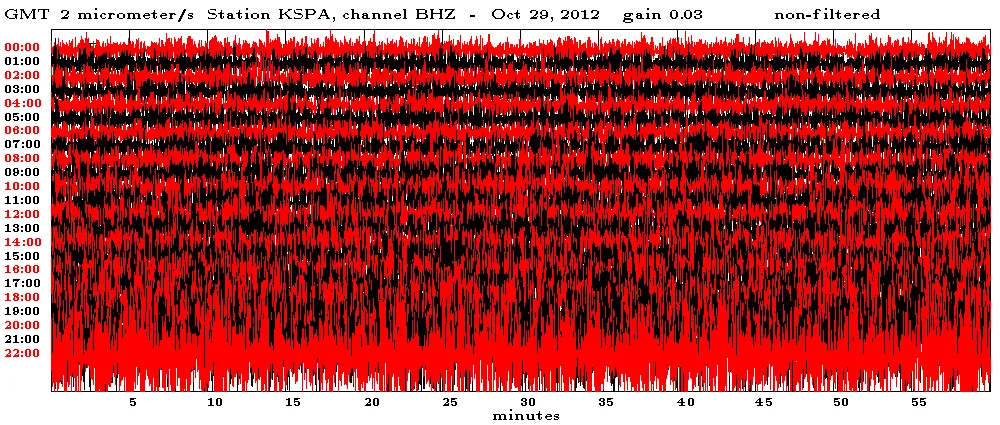
Storm waves crashing on the beach around noon EDT (16:00 GMT) on Oct. 29 were recorded by a seismometer in northern Pennsylvania. The back-and-forth swing of the needle broadens about six hours later, not long before Hurricane Sandy's landfall.
As heavy surf hammered the Northeast Monday afternoon before Hurricane Sandy's landfall, the weather was peaceful in northern Pennsylvania.
At Keystone College, in the small town of La Plume, a seismometer scratched out a warning. Even more than 100 miles (161 kilometers) inland, the instrument picked up the power of waves churned by Sandy's winds.
While seismometers are meant to measure earthquakes, the instruments, which detect very subtle movements in the Earth's crust, also commonly record explosions, trucks on the highway and ocean waves crashing on the beach, said Ian Saginor, a professor and volcanologist at Keystone College who monitors the seismometer.
A typical seismometer recording from a quiet day at Keystone College in Pennsylvania.
(Image credit: Ian Saginor, Keystone College)
The instrument recordings show storm activity starting to ramp up around noon on Monday, Oct. 29, while Hurricane Sandy was still offshore of New Jersey. The back-and-forth swing of the needle broadens widely about six hours later, not long before the storm's landfall.
"That ramp-up is when the waves, the storm surge was coming in," Saginor told OurAmazingPlanet. "The ramp-up in Pennsylvania is happening long before any winds are getting there," Saginor said. "In Pennsylvania, there was no storm."
Saginor said he first noticed the instrument picking up storm waves during the Christmas blizzard in 2010 — but only after the storm passed through.
"When I first noticed it, I didn't understand why our seismometer was so noisy," he said. Then he realized, "If a storm is traveling from west to east, the noise is going to ramp up after the storm passes over us and hits the coast. That's when the storm starts sending energy back," Saginor said.
Sign up for the Live Science daily newsletter now
Get the world’s most fascinating discoveries delivered straight to your inbox.
Becky Oskin covers Earth science, climate change and space, as well as general science topics. Becky was a science reporter at Live Science and The Pasadena Star-News; she has freelanced for New Scientist and the American Institute of Physics. She earned a master's degree in geology from Caltech, a bachelor's degree from Washington State University, and a graduate certificate in science writing from the University of California, Santa Cruz.