














Rare Sea Creature Climbs onto Seattle Woman's Dock
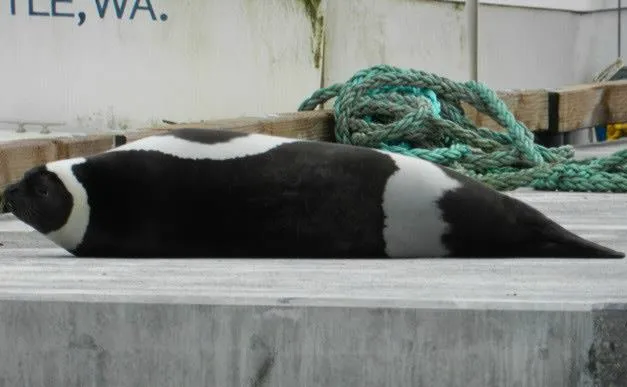
A Seattle resident recently got a big surprise when she discovered a strange-looking furry visitor on her property.
"She woke up and it was lying on her dock, hanging out and sleeping — just chilling," said Matthew Cleland, district supervisor in western Washington for the USDA's Wildlife Services, and the recipient of a photo of the bizarre intruder.
"I thought, 'That's an interesting-looking creature,'" Cleland told OurAmazingPlanet. "I had no idea what it was."
A quick glance through a book in his office soon revealed it was a ribbon seal, an Arctic species that spends most of its life at sea, swimming the frigid waters off Alaska and Russia.
Somehow, the seal turned up on the woman's property, about a mile from the mouth of the Duwamish River, a highly industrialized waterway that cuts through southern Seattle. In 2001, the EPA declared the last 5.5 miles (9 kilometers) of the river a Superfund site — an area contaminated with hazardous substances in need of cleanup.
The sighting was "pretty exciting," said Arctic seal researcher Peter Boveng, leader of the National Marine Mammal Laboratory's Polar Ecosystems Program. "It's really unusual."
Ribbon seals, named for the unmistakable stark white markings that ring their necks, flippers and hindquarters, typically shun dry land.
Get the world’s most fascinating discoveries delivered straight to your inbox.
Boveng said the animals spend only a few months per year on sea ice, to molt and give birth, and have almost never been seen so far south. "So it's a surprise, but knowing the species, it's not a complete surprise to me," he said. "They're good travelers."
The ribbon seal, which Boveng identified as an adult male, "looked to be in really good shape," he said. "We don't have any way to rule out other possibilities, but I'd say it's almost certain that it swam there."
Satellite tracking studies have revealed that ribbon seals do sometimes make it as far as the north Pacific Ocean, south of the Aleutian islands, but much about the species remains mysterious. Because they spend so much of their lives in the open water, it's a challenge to track them.
"Unfortunately we don't know a lot about their numbers," Boveng said. "There's never been a reliable survey."
A conservation groups has made efforts to list ribbon seals as an endangered species because of concerns about disappearing sea ice in the Arctic. So far the federal government has declined to do so, but is continuing to review the case for listing.
The Seattle ribbon seal appears to be only the second on record to make it so far south.
In 1962, a ribbon seal showed up on a beach near Morro Bay, Calif., a town about 200 miles (320 kilometers) north of Los Angeles. According to contemporary reports, the seal was in good shape, but totally bald except for hair on the head, neck and flippers. It died a month later at the local aquarium.
The Seattle ribbon seal's story is unknown, but one could be forgiven for thinking it a harbinger of things to come. This week, cold winds from Alaska helped create a record winter storm in Seattle, slamming the metro area with 4 to 8 inches (10 to 20 centimeters) of snow.
The ribbon seal hasn't been seen again since it was first spotted last week.
"It stirred up a lot of interest," Cleland said. "There are a lot of people out here looking for it."
- Gallery: Seals of the World
- Gallery: Amazing Creatures from the Census of Marine Life
- Images: Antarctic Seals Go Where Scientists Can't
Reach Andrea Mustain at [email protected]. Follow her on Twitter @AndreaMustain. Follow OurAmazingPlanet for the latest in Earth science and exploration news on Twitter @OAPlanet and on Facebook.