














Ancient Algae Shed Light on Antarctic Ice Sheet Growth

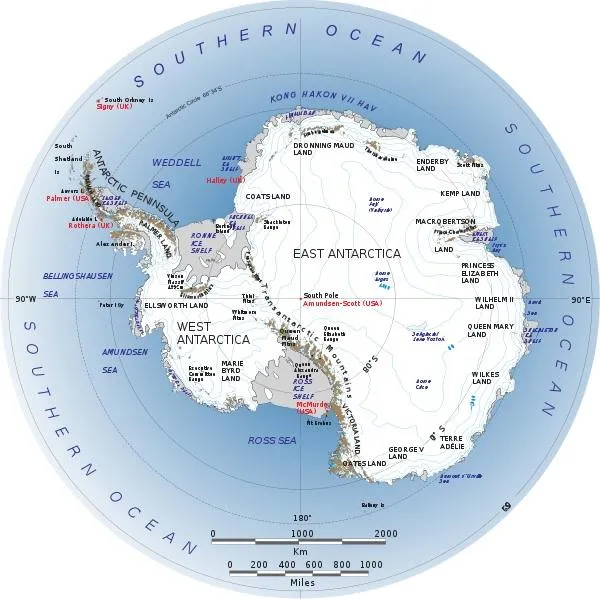
Antarctica's vast ice sheets first grew when carbon dioxide levels in the Earth's atmosphere sharply declined millions of years ago, scientists now find.
Carbon dioxide is a greenhouse gas — it traps heat radiating away from the Earth's surface. High levels of it in the atmosphere are linked with global warming, while low levels are linked with global cooling. Many such periods of warming and cooling have occurred in the Earth's history, with repercussions for climate around the planet.
But reconstructions of what atmospheric carbon dioxide levels were like back when glaciers began to cover Antarctica nearly 34 million years ago had appeared contradictory. Some research actually suggested carbon dioxide levels rose just before and across this time, a period known as the Eocene-Oligocene climate transition, which is the opposite of what would be expected as prime glacier-growing conditions.
Now research suggests that a sharp decline of atmospheric carbon dioxide levels may have played a major role in seeding Antarctica's glaciers.
Ancient algae
Scientists investigated alkenones — tough organic compounds only produced by certain types of algae — to find the carbon dioxide signatures of this period. These photosynthetic organisms would have used carbon dioxide that entered the water from the air, so looking at the chemical makeup of ancient deposits of alkenones can give an idea of what levels of the gas were like in the past.
Paleoclimatologist and geochemist Mark Pagani at Yale University and his team collected alkenones at six deep sea locations across the planet. They sampled spots both near and far from the poles, to get a better sense of what global atmospheric carbon dioxide levels were like during this particular period.
Get the world’s most fascinating discoveries delivered straight to your inbox.
The investigators focused on carbon isotopes within these compounds. All isotopes of an element have the same number of protons, but each has differing number of neutrons — for instance, carbon-12 has six neutrons, while carbon-13 is heavier with seven.
The more carbon dioxide there is in the water — and thus air — the more often alkenones are made up of lighter carbon isotopes. This is because the enzyme that helps the algae suck in carbon dioxide prefers such isotopes, and the more of the gas there is overall, the more chances this enzyme has to absorb the carbon it likes.
Climate correspondence
By looking at carbon isotope ratios within the alkenones, the researchers found that carbon dioxide apparently decreased in the atmosphere just prior to and during the onset of glaciations in Antarctica. The contradictory alkenone findings published previously — ones from Pagani and his colleagues — likely came from locales with high levels of carbon dioxide that did not reflect what global levels overall were like, Pagani said.
"The research supports a clear correspondence between carbon dioxide and climate change," Pagani told OurAmazingPlanet. "This is not a great surprise to those of us who study the history of Earth's climate, but given the politicization of science these days, connecting the dots between carbon dioxide and climate is increasingly important."
"The geologic record is just waiting to reveal the nature of climate sensitivity to carbon dioxide and other greenhouse gases," Pagani added. "Further carbon dioxide investigations of very warm periods in Earth history and better constraints on global temperatures through time will keep me busy." [How Two Degrees Will Change Earth]
The scientists detailed their findings in the Dec. 2 issue of the journal Science.
