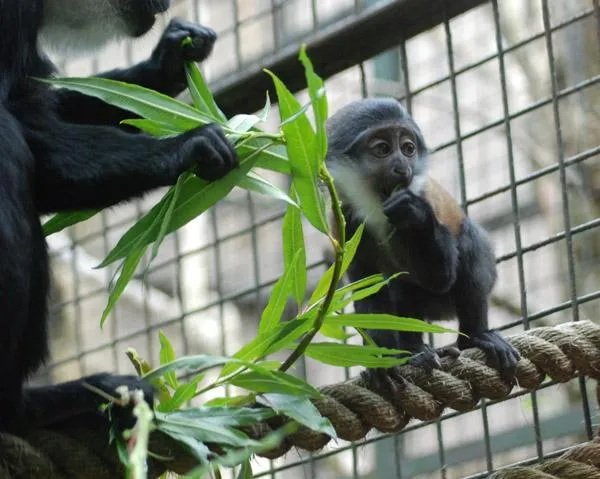
Visitors to the monkey house at Edinburgh Zoo have been meeting the Zoo's latest arrival, an inquisitive orange-eye baby L'hoest's monkey.
The birth of this baby L'hoest's monkey has special significance, as the baby's mum, Tumbili, brought new genetics to Edinburgh from North America.
Animal Team Leader Lorna Hughes said: Every birth is special, but this one has been really exciting. Tumbili came to Edinburgh from San Diego Zoo about eight months ago, bringing new genetics with her which will strengthen biodiversity here and in zoos throughout Europe.
Born on June 26th 2011 to mum Tumbili and dad Kizizi, the baby L'hoest's monkey has yet to be given a name but Lorna says the newest arrival is already developing a big personality.
The baby is quite a confident little one. It comes right up to the window to have a look at visitors.
We'll check to see if it is a baby boy or a baby girl when it is about three months old, once the baby has started venturing away from mum a bit more. Once we know, we'll be able to choose a name.
While her baby appears bold and curious, Tumbili is keeping a close eye on the new arrival. Lorna said: Tumbili is a great mum, knowing just what to do and being very caring and protective.
Sign up for the Live Science daily newsletter now
Get the world’s most fascinating discoveries delivered straight to your inbox.
Dad Kizizi was born at Edinburgh Zoo eight years ago and like most male L'hoest's monkeys he has taken a step back and left mum to do the childcare.
(Image credit: Edinburgh Zoo)
At the moment Tumbili's baby is still dependent on her mother's milk but in the coming weeks she'll be starting to try new foods. Lorna said: She'll start to learn new tastes and new skills like how to forage for food and how to unpeel fruit.
In the wild L'hoest's monkeys live in the tropical forests of Rwanda, Uganda and the Democratic Republic of Congo, spending most of their time on the forest floor. Their diet is made up mostly of fruit, leaves, mushrooms and sometimes insects and lizards. They live in social groups usually made up of one dominant male and several related females.
Deforestation and hunting means L'hoest's monkeys are facing a high risk of extinction in the wild and they are marked as vulnerable on the IUCN Red List.
You can help protect the future of the L'hoest's monkey, and support the charitable conservation work of Edinburgh Zoo, by adopting an animal, becoming a member of the Zoo or by making a donation.
For the science geek in everyone, Live Science offers a fascinating window into the natural and technological world, delivering comprehensive and compelling news and analysis on everything from dinosaur discoveries, archaeological finds and amazing animals to health, innovation and wearable technology. We aim to empower and inspire our readers with the tools needed to understand the world and appreciate its everyday awe.