














San Andreas Drill Project Probes Earthquakes' Inner Workings

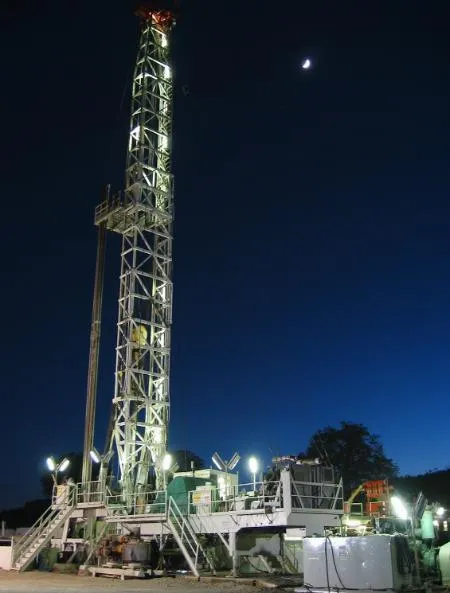
Scientists have drilled more than 1.5 miles (2.4 kilometers) into the Earth to take samples of rock from inside an earthquake fault to better understand the mechanisms that drive these quakes.
The research is part of the San Andreas Fault Observatory at Depth (SAFOD ), a massive undertaking that involves an international team of scientists and engineers who hope to one day find a way to predict when a dangerous quake is imminent.
"There's roughly a dozen major plates that the Earth's surface is broken up into and this is one of the first times we've ever been able to drill into one of those boundaries between the tectonic plates," said geologist Chris Marone, a professor at Pennsylvania State University, in a statement. "We know very little of what's within these fault zones."
The drill site is centered along the infamous California fault near the small town of Parkfield, Calif., located midway between Los Angeles and San Francisco.
By looking at the nature of the rocks that comprise the fault, scientists hope to better understand why it sometimes lurches violently, and why it sometimes moves at a snail's pace, producing slow-motion earthquakes that aren't perceptible at the surface.
One group is recreating in the lab the conditions that rocks inside the fault might experience during an actual earthquake, applying stress and pressure to the rock.
"At that point, we try to measure the strength and behavior of the sample," said Penn State geologist Brett Carpenter
Get the world’s most fascinating discoveries delivered straight to your inbox.
Demian Saffer, a hydrogeologist at Penn State who is testing rock samples from the fault to see how easily water can push through them, said the retrieved rocks from the drill site were fairly impermeable.
"It's very difficult for water to flow through," Saffer said in a statement.
Anthony Crone, a research geologist with the U.S. Geological Survey, said studying the relationship between fluid and rocks inside the fault is important.
"We know that fluids do have an effect on how easily or how difficult it is for a fault to slip," Crone said, adding that the SAFOD drilling project has provided invaluable material for study.
"It's the first time we've been able to physically sample a fault at depths where at least small earthquakes have occurred," Crone told OurAmazingPlanet.
Earlier research on samples taken from the drill site indicate the portion of the San Andreas Fault near Parkfield is greased up with a razor-thin layer of clays, one possible reason the fault moves at a snail's pace in the region, producing slow-motion earthquakes instead of breaking suddenly to produce a damaging earthquake.
"The work that's happening on the SAFOD core right now is generating a lot of interest in going back, re-instrumenting the borehole and maybe doing more coring and drilling in the future because we don't know everything that we could know from that place," Marone said.
