














'Amazing Flows' of Ice in Antarctica Revealed

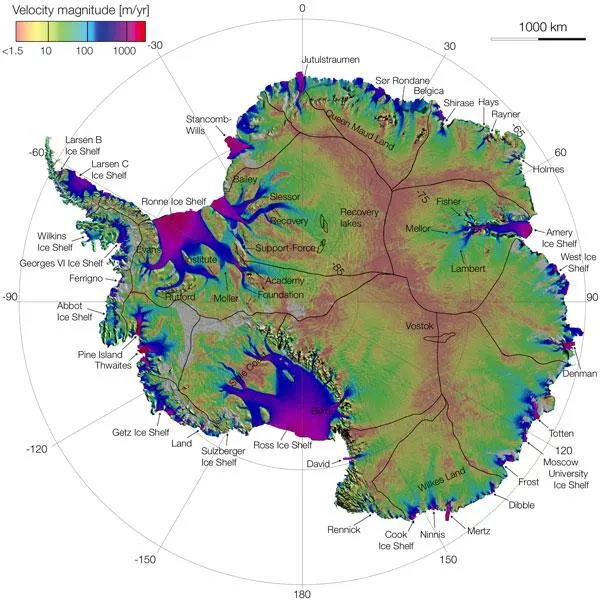
The first detailed map of ice flow across the entire continent of Antarctica has been developed, showing "amazing flows" from the continent's center that have never before been seen.
"We're seeing amazing flows from the heart of the continent that had never been described before," said researcher Eric Rignot, a glaciologist at the University of California, Irvine and NASA's Jet Propulsion Laboratory. "This is like seeing a map of all the oceans' currents for the first time."
Since the vast majority of Earth's ice is located on Antarctica, and melting polar ice sheets could potentially dramatically raise sea level, the new digital mosaic released today could help researchers understand how Antarctica might change under the steadily warming global climate.
Antarctica's ice sheet is made up of glaciers, which are essentially slowly flowing rivers of ice. The glaciers end in ice shelves, which float on the ocean's surface and occasionally spawn icebergs.
Conventionally, ground-based stations measure Antarctic ice movements, but there are relatively few stations compared with the size of the southernmost continent, which has led to an incomplete picture of these motions.
To look over all of Antarctica, the new map incorporated high-resolution satellite radar data of the continent's ice flows from the Canadian Space Agency, the European Space Agency and the Japan Aerospace Exploration Agency between 2007 and 2009.
It reveals that ice motions on Antarctica depend mostly on a vast, complex network of narrow rivers of ice reaching hundreds of miles over the whole of the continent. [Video: See where the ice rivers are.]
Get the world’s most fascinating discoveries delivered straight to your inbox.
Ice flows through these previously unmapped glaciers at rates averaging about 100 feet (30 meters) per year; the flow is caused by the ice sheets sliding on their rocky beds. Surprisingly, these motions are twice as fast as flows that happen over a wider area when the ice sheets warp their shape to ooze across the surface, which scientists had thought played the lead role for ice movements on the continent.
The dominant role that such tributaries have in Antarctica is likely a common feature of ice sheets, researchers added. The other major ice sheet on Earth is the one that covers Greenland.
Both of these ice sheets are important potential contributors to sea level rise in a warming world.
"Knowing the exact flow pattern of the ice from the interior regions to the coast has important implications for estimating how these ice sheets will contribute to sea level change in the future," Rignot told OurAmazingPlanet. "And Antarctica is the largest potential contributor to sea level rise."
The scientists detailed their findings online August 18 in the journal Science.
- Video: Giga-Tons of Ice Crawl Off Antarctica
- Earth in the Balance: 7 Crucial Tipping Points
- The Coldest Places on Earth
