














Arctic Landscape Anything But Boring
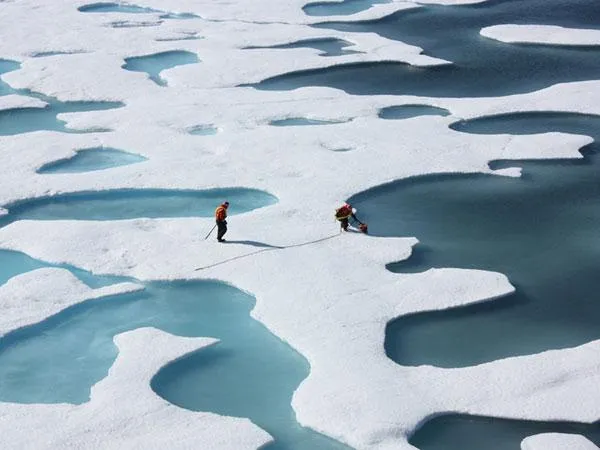
The Arctic may conjure images of a monotonous sheet of white ice as far as the eye can see. But in reality, that ice is anything but uniform.
The sea ice atop the Arctic Ocean can as shown in this photograph from July 12, 2011 look quite varied.
The areas of blue in the image are called melt ponds. As ice melts, the liquid water collects in depressions on the surface of the sea ice and deepens them, forming melt ponds, according to a NASA statement. These fresh water ponds are separated from the salty sea below and around it, until breaks in the ice merge the two.
Researchers on the NASA-funded ICESCAPE mission (Impacts of Climate on Ecosystems and Chemistry of the Arctic Pacific Environment) have been examining melt ponds, the ice around them and the waters below for three weeks, with three more to go. Carried by the U.S. Coast Guard Cutter Healy, a team of oceanographers, marine biologists and glaciologists are investigating how changing conditions in the Arctic affect the ocean's chemical and biological makeup.
Yes, biological. Arctic sea ice isn't as barren as it may look, with bacteria and other microscopic creatures calling it home. The science team collects water samples to examine water chemistry and to observe the colonies of plankton growing in the water and on the surfaces of the ice.
Other instruments are used to assess how much and how far sunlight is penetrating into and warming the Arctic Ocean. Still others are measuring the current systems that move water from the depths to the surface, as well as horizontally across the Beaufort and Chukchi Seas.
The crew members in the photo are collecting supplies. A C-130 airplane flew by earlier in the day, dropping a parachuted canister of hardware for fixing instruments and other machinery on the icebreaker.
Get the world’s most fascinating discoveries delivered straight to your inbox.
- On Ice: Stunning Images of Canadian Arctic
- Extreme Living: Scientists at the End of the Earth
- North vs. South Poles: 10 Wild Differences