













Young Musicians Get Smarter, Study Suggests
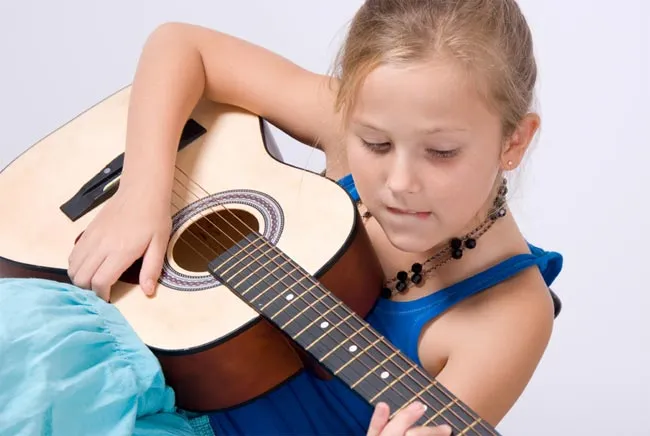
Children who study a musical instrument for at least three years outperform children with no instrumental training on non-musical tests of vocabulary and non-verbal reasoning.
This new finding adds to a list of music's magic. Past research has shown tunes can evoke strong memories, reduce stress and even boost athletic performance.
Resarchers compared 41 kids, ages 8 to 11, who had studied either piano or a string instrument for at least three years, with 18 children who had no instrument training. Children in both groups spent about half an hour each week in music classes at school. But instrument-wielding kids also attended private music lessons for an average of 45 minutes a week and practiced on their own at home.
Tests showed the kids who practiced instruments scored much higher than their non-musical counterparts on auditory discrimination and finger dexterity, both skills closely tied with musical training.
The young musicians' vocabulary scores were 15 percent higher, and non-verbal reasoning scores were 11 percent higher. The longer the child was musically trained, the higher the scores.
The study was done by Gottfried Schlaug of Beth Israel Deaconess Medical Center and Harvard Medical School, and psychologist Ellen Winner of Boston College and Project Zero, Harvard Graduate School of Education, and their colleagues. The findings were detailed in the Oct. 29 issue of the online journal PLoS ONE.
While the results suggest a link between music training and cognitive abilities, the researchers say further studies are needed to figure out whether one causes the other.
Get the world’s most fascinating discoveries delivered straight to your inbox.
"It could be that kids who are better at these skills to begin with are the ones who stick with music training," Winner said. "So if I'm a really smart kid I'm more likely to stick with music training."
She added, "But it could also be that music training is improving my verbal and my non-verbal reasoning."
In a follow-up study, Winner's team is following students from the beginning of their music training, measuring cognitive skills along the way. If they do find a causal link between music and brainy tests, Winner said it would make sense.
"Music involves grasping patterns, and the non-verbal reasoning task involves grasping patterns," Winner told LiveScience. "You have to pay attention to the pattern of sounds, and you also have to pay attention to the pattern of the notes when you're looking at music notation."
The research was funded by the Dana Foundation, International Foundation for Music Research and National Science Foundation.
- Top 10 Mysteries of the Mind
- Video: Laptop Orchestra – The Next Step in Computer Music
- Why Do We Love Music?
Jeanna Bryner is managing editor of Scientific American. Previously she was editor in chief of Live Science and, prior to that, an editor at Scholastic's Science World magazine. Bryner has an English degree from Salisbury University, a master's degree in biogeochemistry and environmental sciences from the University of Maryland and a graduate science journalism degree from New York University. She has worked as a biologist in Florida, where she monitored wetlands and did field surveys for endangered species, including the gorgeous Florida Scrub Jay. She also received an ocean sciences journalism fellowship from the Woods Hole Oceanographic Institution. She is a firm believer that science is for everyone and that just about everything can be viewed through the lens of science.