














Antarctic Icebergs Cast Long Shadows

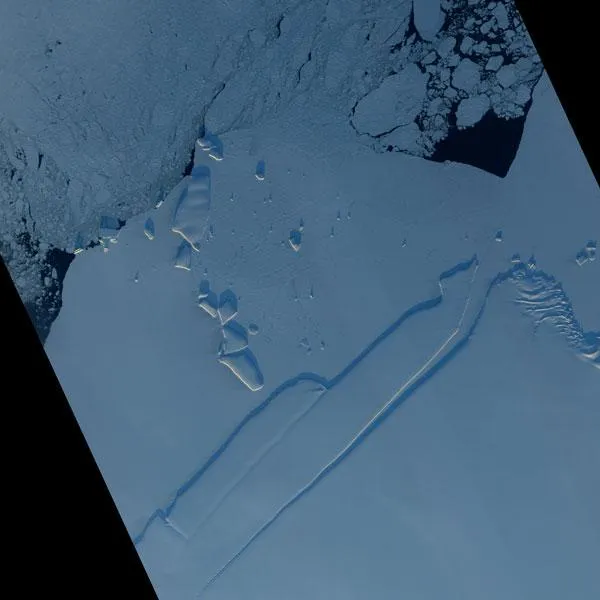
The sun is always up in December in Antarctica. While it's winter in the Northern Hemisphere, it's summer in the southern, and around the South Pole, the sun shines 24/7. But the sunlight strikes from a low angle as it makes a daily circle around the horizon.
Icebergs cast long shadows over the surrounding sea ice in this image, taken Dec. 13, 2010 by the Advanced Land Imager (ALI) on NASA's Earth Observing-1 (EO-1) satellite.
The picture shows icebergs along the Princess Ragnhild Coast in East Antarctica. Besides distinguishing between icebergs and thinner ice, the low-angled sun highlights the differences between the icebergs themselves.
Near the top center of the image, two large icebergs have smooth surfaces. The iceberg next to them, and others along the left and right edges of the image, have mottled surfaces. The differences in texture indicate different histories, scientists at NASA's Earth Observatory explained.
The icebergs with rough surfaces likely broke off from the coast, far from this area, and spent time bobbing over the open ocean.
Wave action applied pressure to the bottoms and sides, and the pressure propagated up through the ice to the surface. Weak spots fractured, and bits of snow and ice fell into the cracks, widening them further. The icebergs you see above likely bear scars from such jostling. By contrast, smooth icebergs likely originated in this area and have not yet traveled far.
Surrounding the icebergs are two kinds of ice: sea ice and fast ice. Along the left edge of the image, the sea ice is thinner, with gaps that reveal the dark ocean below. Clinging to the shore, fast ice is thicker, although not nearly as thick as the icebergs.
Get the world’s most fascinating discoveries delivered straight to your inbox.
- In Images: Antarctica, Iceberg Maker
- Image Gallery: Life at the North Pole
- Image Gallery: Life at the South Pole
