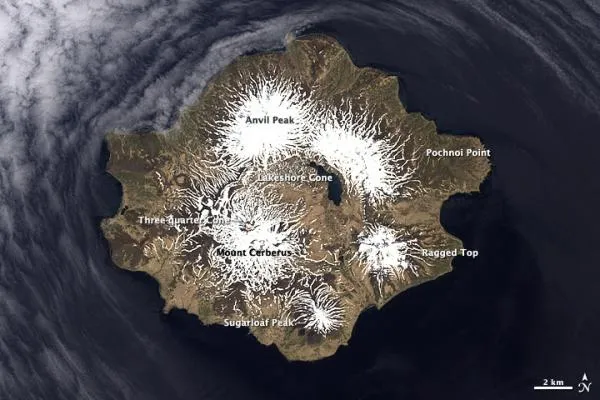
An uninhabitated island at the far end of the Aleutian chain is simultaneously the most easterly and westerly point of the United States of America.
Its name, Semisopochnoi Island, means roughly "Island of the Seven Mountains" in Russian (or more precisely "having seven hills"). The seven hills of the island are volcanic peaks, each with a summit crater, including Cerberus, Sugarloaf Peak, Lakeshore Cone, Anvil Peak, Pochnoi, Ragged Top, and Three-quarter Cone.
Roughly 1,275 miles (2,050 kilometers) west-southwest of Anchorage, Alaska, Semisopochnoi lies near the 180-degree line of longitude, in the Rat Islands group in the western Aleutian Islands .
The volcanic island is also an important nesting area for maritime birds of the North Pacific.
This pseudo-true color image was acquired on June 22, 2000, by NASA's Landsat 7 satellite. In the image, snow is white, bare ground is tan, water is blue, clouds are grey, and vegetation is green.
The high point of the island is Anvil Peak at 4,006 feet (1,221 meters), a double-peaked cone. The three-peaked Mount Cerberus volcano -- 2,539 feet (774 meters) high -- grew up within the caldera as the volcanic hot spot rose up from the sea floor.
Most documented eruptions from the island have come from Cerberus, with the most recent major eruption recorded in 1873. The most recent eruption on the island, though minor, came from Sugarloaf in 1987.
Sign up for the Live Science daily newsletter now
Get the world’s most fascinating discoveries delivered straight to your inbox.
Semisopochnoi has no native land mammals, so it is a natural nesting area for sea birds. But bird populations were decimated after Arctic foxes were introduced to the island for fur farming in the 19th century. In 1997, the last fox was removed from the island to allow the birds a safe refuge again. Part of the Alaska Maritime National Wildlife Refuge (AMNWR), the island now supports more than a million seabirds, particularly auklets, according to the National Audubon Society.
Alaska's Semisopochnoi Island (right). Little Sitkin Island is to the left and Amchitka Island is at the bottom.
For the science geek in everyone, Live Science offers a fascinating window into the natural and technological world, delivering comprehensive and compelling news and analysis on everything from dinosaur discoveries, archaeological finds and amazing animals to health, innovation and wearable technology. We aim to empower and inspire our readers with the tools needed to understand the world and appreciate its everyday awe.