New Imaging of Biggest Crash on Earth Reveals Colliding Continents

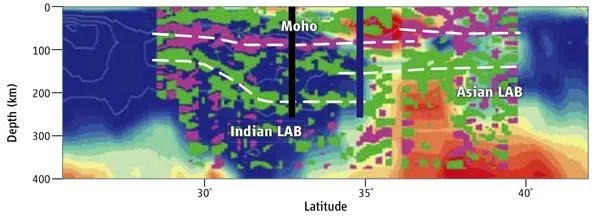
New images are arriving of the largest crash under way on Earth, involving the entire Indian subcontinent diving underneath Tibet.
This giant collision might seem incredibly slow to outsiders, with the subcontinent moving only about 6 feet (2 m) north in the last 50 years. Still, this clash has been relentlessly going on for 50 million years and has raised both the world's highest mountains the Himalayas and the largest and highest plateau on Earth, the Tibetan Plateau, also known as the "Roof of the World."
These titanic movements cause disastrous earthquakes in southern, central and eastern Asia and have strongly influenced world climate by deflecting weather around the landforms they have raised.
To study the deeper structure and collision beneath Tibet, a number of large international experiments are recording seismic waves there. These new studies go beyond the crust of the planet to cover the entire lithosphere, the rigid outermost shell of the planet that includes portions of the upper mantle. They especially focus on the boundary between the shifting tectonic plates of the lithosphere and the hot, churning layer of rock right below it, known as the asthenosphere.
"With new technology, we have learned that the boundary between the rigid lithosphere and the softer asthenosphere is much sharper than previously thought this leads to significant modifications of our understanding of the mobility of the plates and may finally help to reduce dangers for people living in such collision zones," said seismologist Rainer Kind of the German Research Centre for Geosciences in Potsdam.
These findings are yielding large-scale and detailed pictures of this collision of India and Tibet, leading to a much better understanding of it and its consequences.
Shallow slab
Get the world’s most fascinating discoveries delivered straight to your inbox.
The new research has found that the Indian lithosphere runs to a depth of about 120 miles (200 km), while the Tibetan lithosphere is shallower, reaching down to just 90 miles (150 km). As a result, when India and Tibet collide, the mantle that makes up the lower part of the Indian plate's lithosphere is diving beneath Tibet , while the upper crust is getting peeled off, remaining at the surface.
Research is also focusing at the northern and eastern boundaries of Tibet, where the collision might take on a different form.
For instance, at the northern boundary of Tibet, at the Tarim Basin, the lithosphere there is not diving beneath Tibet, but is instead thickening the Tibetan lithosphere. To imagine this, picture a car crash "both cars could be compressed and shortened, or a smaller car could be driven underneath a larger truck," Kind explained. The former is happening at Tibet's northern boundary, while the latter is happening at its southern boundary.
Strange happenings
On the other hand, "strange, not yet fully explained observations are made at the eastern boundary of Tibet, where in May 2008 a larger earthquake caused about 70,000 casualties," Kind told OurAmazingPlanet. "There the collision causes thickening of the Tibetan crust but shallowing of the Tibetan lithosphere-asthenosphere boundary."
The researchers suspect that what is happening in eastern Tibet is a process called delamination, which is somewhat like the "dripping down of honey from a spoon," Kind said. "During [the] collision, the entire Tibetan lithosphere was thickened, but then, for some reason, the lower part of the lithosphere was dripping down, leaving a shallower lithosphere-asthenosphere boundary."
Kind stressed that imaging this massive collision is pure scientific research, "and nobody can predict for what it might be directly useful but without this type of research no subsequent research, like earthquake prediction, can be successful."
Kind and his colleague Xiaohui Yuan detailed these findings in the Sept. 16 issue of the journal Science.