
















Flow of Vast Undersea River Revealed

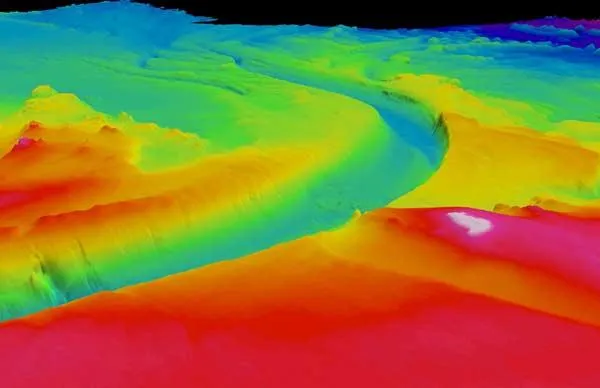
A vast river flowing along the ocean floor has been sketched out for the first time using a robotic submarine.
Researchers estimate that this "undersea river" known as a submarine channel would be the sixth largest river in the world if it were located on land, based on the amount of water flowing through it.
Submarine channels are similar to land rivers, but they are formed by currents of water of different densities mixtures of sand, mud and water are denser than sea water and so sink and flow along the bottom of the ocean .
These channels are the main transport pathway for sediments to the deep sea where they form sedimentary deposits. These deposits ultimately hold not only untapped reserves of gas and oil, but they also house important secrets from clues on past climate change to the ways in which mountains were formed.
Some suspect the submarine channels in the Black Sea were formed around 6,000 years ago when sea levels were approaching their current point. The Mediterranean Sea swelled and breached through into the Black Sea once an isolated freshwater lake via the Bosphorus Strait. As the waters surged, they carried a dense, salty fluid, which formed a network of seafloor channels that are almost constantly active, even today. (Some believe this event was the inspiration for Noah's flood.)
Submarine channels are notoriously difficult to study because of their power and unpredictability. In the past they have been known to destroy scientific equipment, and as a consequence most existing knowledge about them has been obtained from small scale laboratory measurements and from examples of past channels now exposed on dry land.
The first spectacular images of these submarine channels were obtained in 2006, by researchers at Memorial University in Newfoundland, Canada, which are project partners in the new study.
Get the world’s most fascinating discoveries delivered straight to your inbox.
To get a closer look at a submarine channel for the current study, researchers used the UK Natural Environment Research Council's (NERC) Autosub3, a (7-meter-) long torpedo-shaped robot.
Because it has an accurate positioning system, the sub can be programmed to stay just above the channels and safe from damage.
So far, the team is learning that these underwater rivers aren't exactly like their landlubber cousins.
"Our initial findings show that the flow in these channels is quite different to the flow in river channels on land," said project team co-leader Dan Parsons, of the University of Leeds in England. "Specifically as flow moves around a bend it spirals in the opposite direction in the deep sea compared to the spiral to that found in river channels on land. This is important in understanding the sedimentology and layers of sediment deposited by these systems."
The team will use the data obtained to create innovative computer simulations that can be used to model how sediment flows through these channels. The resulting models may have broad applications, including inputting into the design of seafloor engineering by oil and gas companies.
