















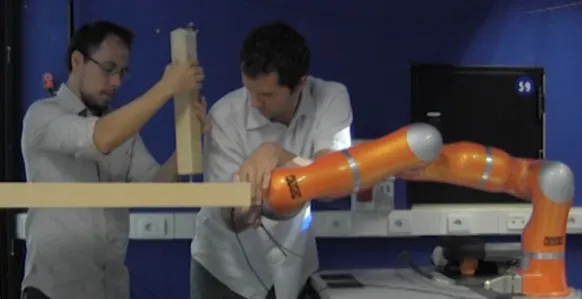
For those who are tired of assembling IKEA furniture, researchers have created a new robot to help with the task.
The robot uses a force sensor and a vision-tracking system to learn how a user wants it to move. Then the robot essentially becomes an extra pair of hands — moving freely when the user tugs on a table top, flipping the tabletop over, and then becoming stiff as a person screws in the legs, Gizmodo reported.
A robot learning to collaborate with a user to assemble an IKEA table from Sylvain Calinon on Vimeo.
Unfortunately, the robot can't do everything. It doesn't know which pieces go where, meaning there could still be some head-scratching involved in assembling the Expedit shelf.
Get the world’s most fascinating discoveries delivered straight to your inbox.

Tia is the editor-in-chief (premium) and was formerly managing editor and senior writer for Live Science. Her work has appeared in Scientific American, Wired.com, Science News and other outlets. She holds a master's degree in bioengineering from the University of Washington, a graduate certificate in science writing from UC Santa Cruz and a bachelor's degree in mechanical engineering from the University of Texas at Austin. Tia was part of a team at the Milwaukee Journal Sentinel that published the Empty Cradles series on preterm births, which won multiple awards, including the 2012 Casey Medal for Meritorious Journalism.