














What If the 1974 Tornado Super Outbreak Happened Today?

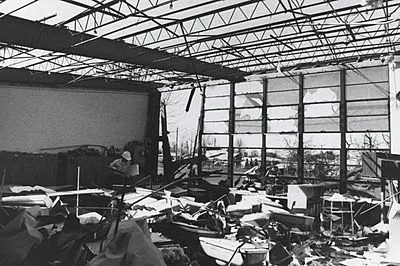
If you were around in 1974, you probably remember the widespread outbreak of violent tornadoes that struck the Midwest, lower Mississippi Valley and Southeast. Some 148 tornadoes swept across the landscape over the course of a mere 18 hours during the Super Outbreak, resulting in the deaths of 315 people in 11 states. Perhaps even more astounding, notes the website United States Tornadoes:
"The 1974 outbreak featured 30 violent tornadoes [F4s and F5s] in less than one day when the national average is only about 7 per year."
Cue the dropped jaws.
Kathryn Prociv at the United States Tornadoes site took a historic map of the outbreak and superimposed it on the most recent census population data to see what impact it would have had in today's world of suburban sprawl. As populations expand on the landscape, there's a higher chance of destruction from tornadoes. Prociv's exploration of the event shows that several suburban areas of major cities would have been very hard hit if the '74 outbreak had occurred today.
Indeed, the April 23-34, 2011, outbreak across the Southeast, which killed 316 people, shows that tornadoes can wreak just as much devastation nearly 40 years after the '74 outbreak.
Read More at United States Tornadoes.
Get the world’s most fascinating discoveries delivered straight to your inbox.

Andrea Thompson is an associate editor at Scientific American, where she covers sustainability, energy and the environment. Prior to that, she was a senior writer covering climate science at Climate Central and a reporter and editor at Live Science, where she primarily covered Earth science and the environment. She holds a graduate degree in science health and environmental reporting from New York University, as well as a bachelor of science and and masters of science in atmospheric chemistry from the Georgia Institute of Technology.