














Fluorescence Could Indicate Health of Corals

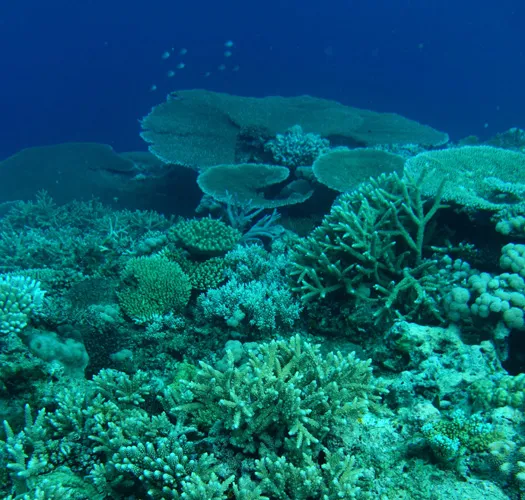
Corals are well-known for the brilliant colors they sport, but less well-known is the light, or fluorescence, that most coral species give off. Monitoring the levels of this fluorescence could be an easier way for scientists to monitor the health of coral reefs around the world, a new study finds, as these reefs are subjected to stress from climate change and other factors.
Coral fluorescence, produced by special fluorescent proteins, is a relatively poorly understood phenomenon, but researchers think it could help protect the coral from damaging sunlight, or possibly other forms of stress.
Marine biologists at the Scripps Institution of Oceanography at UC San Diego monitored the levels of fluorescence and fluorescent proteins in a common branching coral from the Indo-Pacific region called Acropora yongei as the coral was subjected to both cold and heat stress. These stresses both affect corals in nature, with cold snaps sometimes killing corals, and global warming heating up the oceans overall.
Fluorescence levels from the coral in the study declined rapidly in response to both types of stress, initially, but the outcomes of the two tests eventually differed. The coral was able to adapt to the cold temperatures and their fluorescence levels rebounded, but the heat stress caused the corals to bleach, or lose the symbiotic algae that provides corals with the bulk of their nutrition.
Under the heat stress conditions, the fluorescence levels declined at first as they did under the cold stress, but the coral couldn't adapt and the algae were expelled from the corals, study researcher Melissa Roth, now at Lawrence Berkeley National Laboratory and UC Berkeley, told OurAmazingPlanet in an email. When the bleaching happened, there was actually a spike in fluorescence caused by the fact that the algae had previously been shading the fluorescence and now no longer were.
"This is the first study to quantify fluorescence before, during and after stress," said Scripps researcher Dimitri Deheyn in a statement.
The results show that fluorescence can be a good marker of the health of corals. In fact, it could be an easier, less invasive method of monitoring corals than those currently used, including analyzing corals collected from reefs back in labs. Fluorescence can be monitored without disturbing the coral and directly at the reef site, and could indicate that the coral is in poor health before it bleaches. [Video: Humans Hit the Oceans Hard]
Get the world’s most fascinating discoveries delivered straight to your inbox.
Roth said that the coral the study tested, Acropora yongei, would be a good one to monitor in the field because branching corals like it are "very susceptible to bleaching."
"It would make sense to monitor the corals on the reef that are most sensitive as an indicator for the reef as a whole," Roth said.
The findings were detailed in the March 12 issue of the journal Scientific Reports.
Follow Andrea Thompson @AndreaTOAP, Pinterestand Google+. Follow OurAmazingPlanet @OAPlanet, Facebook and Google+. Original article at LiveScience's OurAmazingPlanet.

Andrea Thompson is an associate editor at Scientific American, where she covers sustainability, energy and the environment. Prior to that, she was a senior writer covering climate science at Climate Central and a reporter and editor at Live Science, where she primarily covered Earth science and the environment. She holds a graduate degree in science health and environmental reporting from New York University, as well as a bachelor of science and and masters of science in atmospheric chemistry from the Georgia Institute of Technology.