













How Japan's 2011 Earthquake Happened (Infographic)

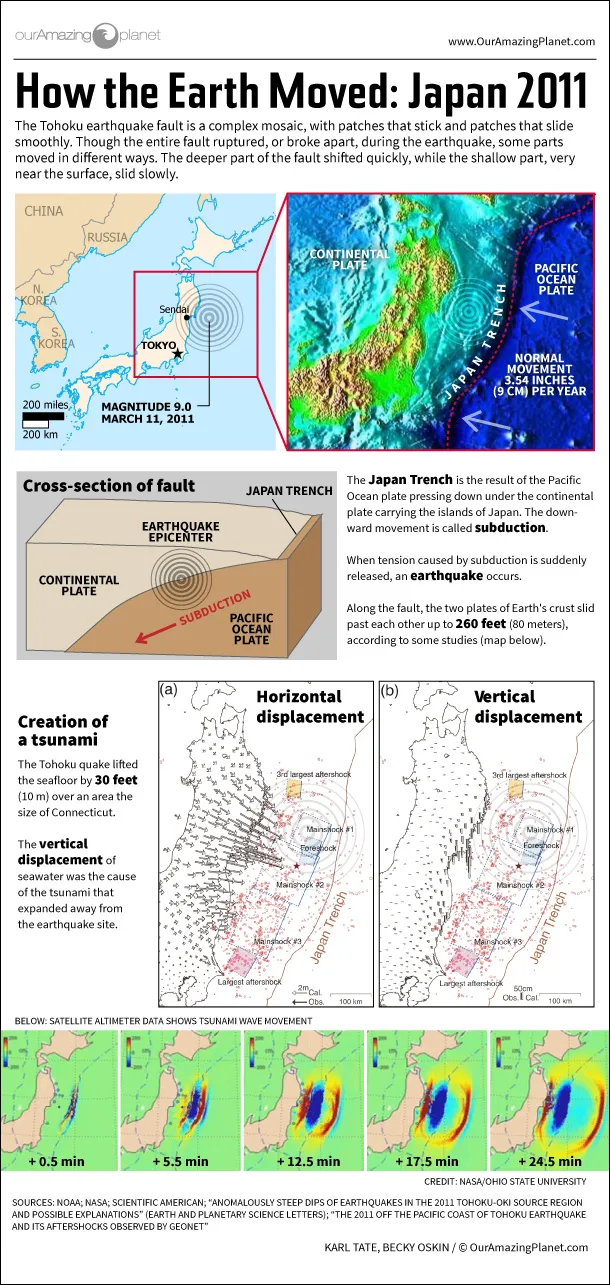
The Tohoku earthquake fault is a complex mosaic, with patches that stick and patches that slide smoothly. Though the entire fault ruptured, or broke apart, during the earthquake, some parts moved in different ways. The deeper part of the fault shifted quickly, while the shallow part, very near the surface, slid slowly.
The Japan Trench is the result of the Pacific Ocean plate pressing down under the continental plate carrying the islands of Japan. The downward movement is called subduction.
When tension caused by subduction is suddenly released, an earthquake occurs.
Along the fault, the two plates of Earth's crust slid past each other up to 260 feet (80 meters), according to some studies.
The Tohoku quake lifted the seafloor by 30 feet (10 m) over an area the size of Connecticut.
The vertical displacement of seawater was the cause of the tsunami that expanded away from the earthquake site.
The magnitude 9.0 Tohoku-Oki quake was the most powerful earthquake known to hit Japan and the fifth-most powerful quake ever recorded. The quake triggered a tsunami that killed thousands of people. The Fukushima Daiichi nuclear power plant was damaged by tsunami flooding, causing multiple meltdowns and a massive release of radioactivity.
Get the world’s most fascinating discoveries delivered straight to your inbox.
