













Captive Hyenas Beat Wild Peers in Puzzle Solving

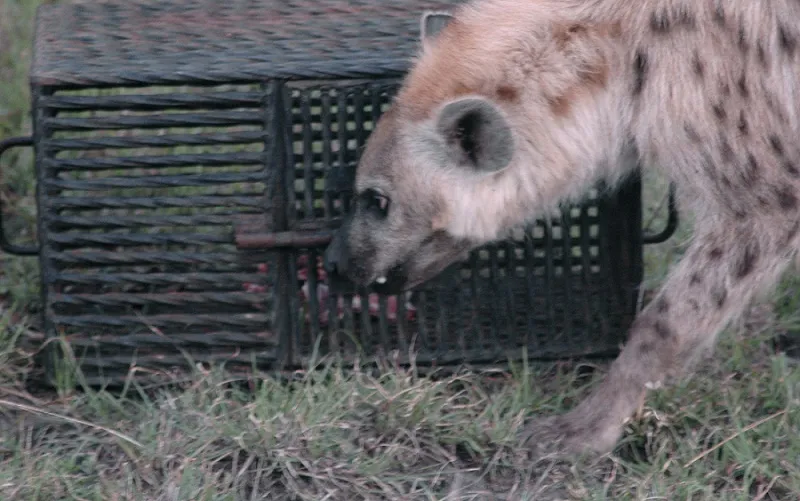
Captive hyenas are much more successful problem solvers than their wild counterparts, a new study has found.
The research illustrates how lessons learned from caged animals, which tend to be more comfortable with new and man-made objects, might not always apply in natural habitats.
Researchers studied how spotted hyenas responded to a steel puzzle box containing raw meat that could be opened by sliding a bolt latch. In more than 400 trials with 62 wild hyenas in Kenya, just nine animals (14 percent) successfully opened the box.
The hyenas that solved the puzzle tested more potential solutions — including biting, flipping or pushing the box — than the ones that failed, but sheer persistence didn't pay off. The wild hyenas had never seen the puzzle box before the experiment and those that quickly approached the foreign object were more likely to get the box open than the hesitant hyenas, the researchers found. (This part of the study was previously described in the journal Proceedings of the Royal Society B.)
Meanwhile, among 19 hyenas in captivity that were presented with the same puzzle box, 14 individuals (73 percent) were able to get it open, and they all succeeded on their first try. Just two of the nine successful wild hyenas opened the box in their first trial.
The clever captive animals seemed more likely to have the traits exhibited by the successful wild hyenas: a willingness to explore and a lack of fear of new objects.
"It doesn't appear that these differences result from captive hyenas having more time or energy," Sarah Benson-Amram, a former Michigan State University researcher, said in a statement. "We conclude they were more successful because they were more willing to tackle the problem and were more exploratory."
Get the world’s most fascinating discoveries delivered straight to your inbox.
Benson-Amram and her colleagues also said it's possible that captivity has an "enculturation effect" on hyenas, meaning they might develop greater cognitive capacities over time due to their interaction with humans and their experience with man-made objects.
Spotted hyenas have relatively large brains and captive ones have been shown to outperform chimpanzees on cooperative problem-solving tests. But the new results suggest captive hyenas might not be the best representatives in studies on the species' abilities.
"We have to be careful when interpreting results from captive animals, as there may be extreme differences between how animals behave in captivity and in the wild," Benson-Amram, who is now a research fellow at the University of St. Andrews in Scotland, said. "An animal that is successful at solving problems in the comfort of its cage may be unwilling to engage in similar problem-solving behavior in the wild."
The new research was detailed recently in the journal Animal Behaviour.
Follow LiveScience on Twitter @livescience. We're also on Facebook & Google+.
