













SAN FRANCISCO — A new technique using GPS and large radio telescopes can detect clandestine underground nuclear tests using waves that travel from the blast into the upper atmosphere, or ionosphere, new research suggests.
The findings, which were presented Tuesday (Dec. 4) here at the annual meeting of the American Geophysical Union in San Francisco, could add to the arsenal the international community uses to detect such rogue tests.
"Both methods are quite effective at finding ionospheric disturbance and finding the underlying source of this disturbance," said Joseph Helmboldt, a radio astronomer at the U.S. Naval Research Academy who conducted the research.
After the Comprehensive Nuclear Test Ban Treaty was adopted by the United Nations in 1996, all but three countries — North Korea, India and Pakistan — signed it. Yet many experts believe countries such as North Korea and Iran are continuing to secretly develop a nuclear arsenal.
To detect rogue nuclear tests, the International Monitoring System deploys a network of more than 250 locations with sensors that detect shock waves from underground blasts, radioactive particles in the atmosphere, and ultra-low frequency sound waves caused by the explosions. (Regarding weapons tests, North Korea has said it will launch a long-range missile this month, drawing condemnation from U.S. officials who say they view the act a thinly veiled ballistic missile test.)
In 2009, North Korea conducted a nuclear test a few hundred miles north of their capitol, Pyongyang. At that time, Dorota Grejner-Brzezinska of Ohio State University and her colleagues were developing ways to improve GPS and noticed that waves from the upper atmosphere were disrupting signals received by GPS satellites. [Satellites Gallery: Science From Above]
When they went back to their calculations, they realized the "noise" actually came from the nuclear test. Because underground nuclear fission tests create powerful forces that rock the Earth's crust, waves form at the surface that then travel into the upper atmosphere, which Grejner-Brzezinska had detected.
Get the world’s most fascinating discoveries delivered straight to your inbox.
Her team then developed an algorithm to pick out such nuclear tests and looked at historical GPS data to see if they could pick out nuclear tests from the past. They could.
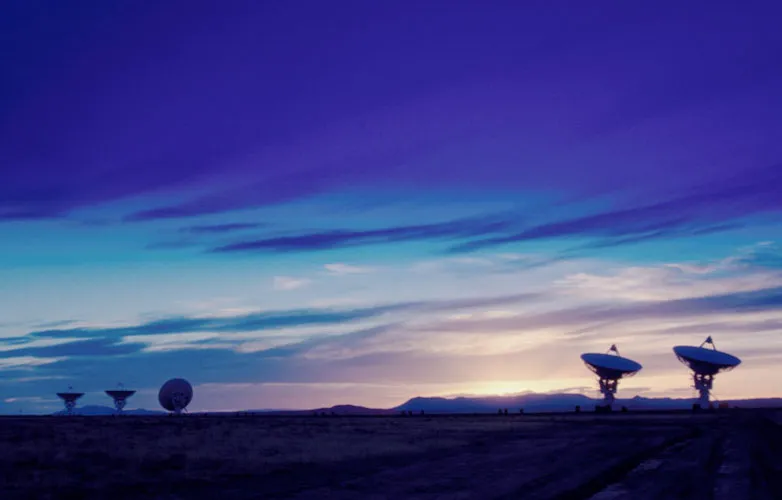
She then contacted researchers at the Very Large Array, a set of 27 iconic radio telescopes placed in the remote New Mexico desert. They pored over their historical records and found they could detect an underground nuclear test that the United States had conducted at Hunters Trophy, Utah, in 1992, Helmboldt said. It turns out, those disruptions in the atmosphere triggered by the nuclear tests actually sort of deform radio waves.
The new techniques haven't been tested to see whether they can distinguish nuclear tests from small earthquakes or mining blasts, he said.
While the new techniques won't replace the existing network, they could eventually complement it, he said.
Since satellites span the globe, they may be able to detect blasts that occur in areas sparsely covered by existing seismology sensors. And if governments reduce how much nuclear blasts shake the Earth, the explosions would probably be even more noticeable by GPS or radio telescopes looking for atmospheric disturbances, Helmboldt said.
"If you were able to devise a way to mitigate how much energy goes into the Earth's crust, the energy has to go somewhere and you would see it go up into the atmosphere," he said.
Follow LiveScience on Twitter @livescience. We're also on Facebook & Google+.

Tia is the editor-in-chief (premium) and was formerly managing editor and senior writer for Live Science. Her work has appeared in Scientific American, Wired.com, Science News and other outlets. She holds a master's degree in bioengineering from the University of Washington, a graduate certificate in science writing from UC Santa Cruz and a bachelor's degree in mechanical engineering from the University of Texas at Austin. Tia was part of a team at the Milwaukee Journal Sentinel that published the Empty Cradles series on preterm births, which won multiple awards, including the 2012 Casey Medal for Meritorious Journalism.