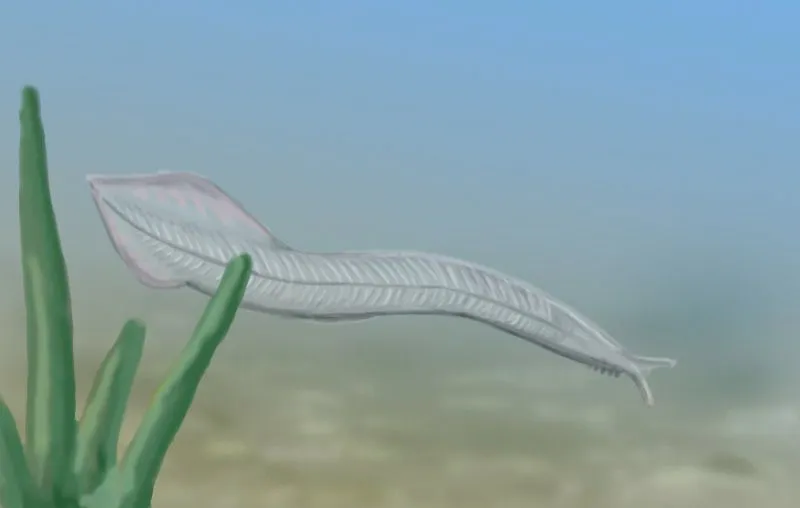
The tiny worm Pikaia gracilens, the earliest known vertebrate ancestor, from the Middle Cambrian of British Columbia, may hold the secret to the expansion of intelligence in vertebrates (animals with backbones).
Several "brainy" genes that were duplicated in a tiny sea creature nearly 550 million years ago may have led to the massive expansion in intelligence in vertebrate species, two new studies have found.
The studies, published today (Dec. 2) in the journal Nature Neuroscience, suggest this duplication of certain genes spurred an explosion in the number of chemicals that regulate brain function in vertebrates (animals with backbones), thereby leading to greater intelligence, the research suggests.
"This genome event produced a kind of cognitive big bang; it produced a large set of interesting behavior," said study co-author Seth Grant, a neuroscientist at the University of Cambridge in the United Kingdom. "It produced a molecular toolbox, which in the case of the brain, produced many, many more proteins that you find in the synapses, the junctions between nerve cells."
The study showed that changes, or mutations, in these genes lead to learning problems in both mice and humans, as well as psychological disorders in humans, said Jeffrey Boore, the CEO of Genome Project Solutions, who was not involved in the study. That supports the notion that these genes "have diversified throughout evolution from their ancient duplications to perform important, specific, diverse roles in mammal cognition in behavior."
Vertebrate explosion
Vertebrates are more intelligent than invertebrates (animals with no backbone), but how those smarts evolved has remained a mystery. In general, vertebrates have many more proteins, which carry out a gene's instructions, in the brain and nervous system; these proteins enable spiny creatures to have a wider, more flexible range of behaviors than invertebrates, Grant said. [Inside the Brain: A Journey Through Time]
"It would be like a stereo or a machine with many more switches in it; it can do more sophisticated types of things," Grant told LiveScience.
Sign up for the Live Science daily newsletter now
Get the world’s most fascinating discoveries delivered straight to your inbox.
Grant and his colleagues wondered whether duplications of certain genes contributed to this explosion in the number of brain proteins, and as a result, to vertebrate intelligence. That's because duplications in genes can give creatures the buffering to evolve more rapidly, Grant said.
(Normally, if a mutation crops up in a gene that's critical to an animal's survival, evolution will weed out that animal, which usually means very little change occurs in critical genes. But if there are two copies of a gene, then the animal has a spare functioning copy, which allows those genes to rack up more mutations — both beneficial, harmful and neutral — without reducing survival fitness.)
In particular, the researchers noticed that vertebrates had multiple copies of two genes that process glutamate, a brain chemical critical for learning and memory. Those genes, which code for the receptor that binds glutamate and the cellular components that process it inside brain cells, were first duplicated in a 2-inch-long (5 centimeters), sea-faring worm called a pikaia that gave rise to all vertebrate species about 550 million yeas ago.
Gene duplications in the ancient sea worm Pikaia (fossil specimen shown here at the Smithsonian) some 550 million years ago may explain vertebrate smarts.
(Image credit: Public Domain)
Roots of intelligence
To see whether that duplication formed the genetic origin of intelligence in vertebrates, Grant's team subjected mice with different mutations in these genes to a battery of visual tests that assess learning and attention in changing environments. Different mutations led mice to perform better or worse on cognitive tests, which implied that these genes play a key role in mouse intelligence.
Moreover, the team showed humans and mice carrying the same mutation in a specific glutamate-transporting gene have reduced adaptive learning, suggesting these genes control intelligence and learning across vertebrate species. (In humans, this gene mutation is linked to schizophrenia.)
The findings suggest those first gene duplications probably also gave rise to rapid evolution in the nervous-system proteins that interact with the glutamate receptor, enabling vertebrates to have more subtle, sophisticated responses to their environment.
"Our evidence shows unambiguously that these genome duplications and expansions in the gene family have produced greater complexity to the behavioral repertoire of the vertebrate," Grant said.
Tia is the editor-in-chief (premium) and was formerly managing editor and senior writer for Live Science. Her work has appeared in Scientific American, Wired.com, Science News and other outlets. She holds a master's degree in bioengineering from the University of Washington, a graduate certificate in science writing from UC Santa Cruz and a bachelor's degree in mechanical engineering from the University of Texas at Austin. Tia was part of a team at the Milwaukee Journal Sentinel that published the Empty Cradles series on preterm births, which won multiple awards, including the 2012 Casey Medal for Meritorious Journalism.