















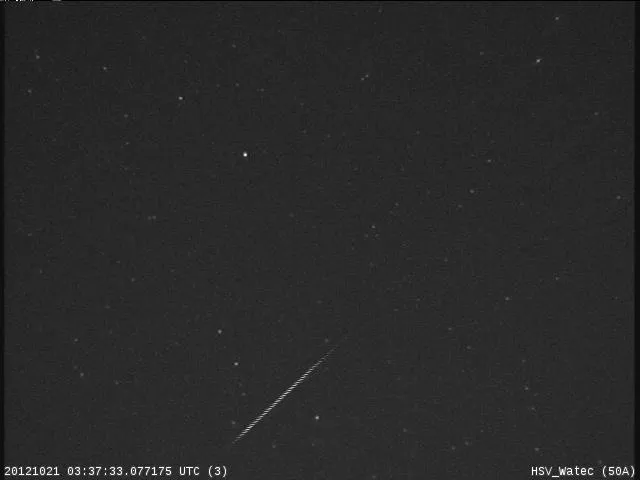
The Taurid meteors, sometimes called the "Halloween fireballs," show up each year between mid-October and mid-November, but Nov. 5 to 12 will likely be the best time to look for them this year, based on their peak of activity and the effect of moonlight on viewing conditions.
Initially, on Nov. 5 the moon will be very bright in the gibbous phase, but it will diminish in brightness with each passing night. Before the moon rises — around 10:30 p.m. on Nov. 5, and about 55 minutes later on subsequent nights — some 10 to 15 meteors may appear per hour. They are often yellowish-orange and, as meteors go, appear to move rather slowly.
The name of this meteor shower comes from the way they seem to radiate from the constellation Taurus, the Bull, which sits low in the east a couple of hours after sundown and is almost directly overhead by around 1:30 a.m. local time.
Meteors, popularly referred to as "shooting stars," are generated when debris enters and burns up in Earth's atmosphere. In the case of the Taurids, they are attributed to debris left behind by
Encke's Comet, or perhaps by a much larger comet, which, upon disintegrating, left Encke and a lot of other rubble in its wake.
Indeed, the Taurid debris stream contains noticeably larger fragments than those shed by other comets, which is why in certain years — and 2012 is predicted to be one — this rather elderly meteor stream occasionally delivers a few unusually bright meteors known as "fireballs." [Amazing Perseid Meteor Shower Photos of 2012]
Two streams for the price of one
Get the world’s most fascinating discoveries delivered straight to your inbox.
The Taurids are actually divided into the Northern Taurids and the Southern Taurids.
This is an example of what happens to a meteor stream when it grows old. Even at the beginning, the particles could not have been moving in exactly the same orbit as their parent comet; their slight divergence accumulates with time.
Meanwhile the sun is not the only body gravitationally controlling the particles' orbits; the planets are having subtle effects on the stream as well. As the positions of the planets are constantly changing, the particles pass nearer to them on some revolutions than others, diverting parts of the stream, fanning it out and splitting it. Ultimately, what was originally one stream diffuses into a cloud of minor streams and isolated particles in individual orbits, crossing Earth's orbit at yet more widely scattered times of the year and coming from more scattered directions until they are entirely stirred into the general haze of dust in the solar system.
Dr. Victor Clube, an English astrophysicistand an expert on comets and cosmology, indicated back in 1992 that the Taurid meteor stream contains perhaps a half a dozen full-size asteroids whose orbits place them squarely in the stream.
Clube and his colleagues argue that the Taurids' range of orbits indicates they were all shed by a huge comet, originally 100 miles across or more, that entered the inner solar system some 20,000 years ago. By 10,000 years ago it was parched and brittle. Encke's Comet might actually be the biggest leftover chunk of the parent comet.
Another fireball year?
Encke's has the shortest known orbital period for a comet, taking only 3.3 years to make one complete trip around the sun. Meteor expert David Asher has also discovered that Earth can periodically encounter swarms of larger particles in certain years, and 2012 is predicted to be one of those years.
Maximum rates for the southern branch occur near Nov. 5, while the northern branch peaks near Nov. 12. This year the moon is somewhat unfavorable during the first week of November, but the northern Taurids peak the day before new moon when the sky will be dark.
The meteor showers' two radiants (the points where meteors appear to originate in the sky) lie just south of the Pleiades star cluster. During the next couple of weeks, if you see a bright, slightly tinted orange meteor sliding rather lazily away from that famous little smudge of stars, you can feel sure it is a Taurid.
The year 2005 was a swarm year, with many exceptional fireballs seen, especially along the U.S. East Coast on Halloween evening (Oct. 31), when fireballs as bright as the full moon were witnessed.
Will 2012 offer a repeat performance? Only by going out and viewing this display will we know for sure!
This story was provied by SPACE.com, sister site to LiveScience. Joe Rao serves as an instructor and guest lecturer at New York's Hayden Planetarium. He writes about astronomy for The New York Times and other publications, and he is also an on-camera meteorologist for News 12 Westchester, New York.
