













Pretty in Pink: Photos of Bubblegum Coral

Bubblegum Coral

There are several species of bubblegum coral, but researchers have found on in particular, Paragorgia arborea, is quite cosmopolitan, with a single species of the knobby-armed structures migrating nearly everywhere outside of the tropics.
Cosmo Coral
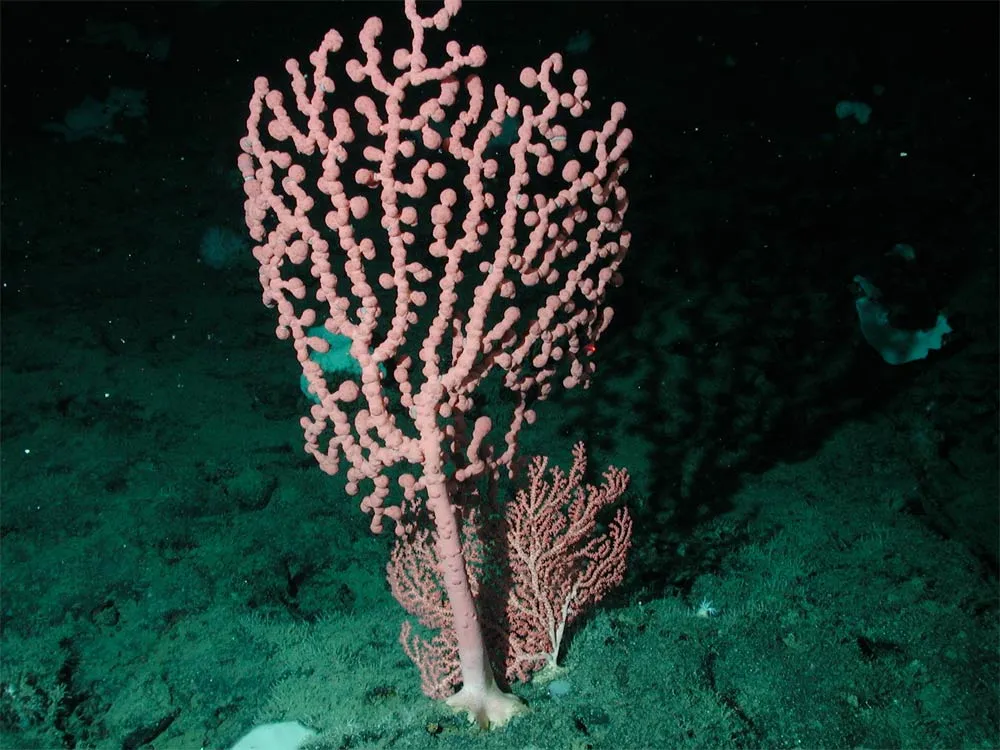
The genetic study detailed Oct. 23, 2012, in the journal Molecular Ecology suggests the coral's ancient migration started in the North Pacific more than 10 million years ago, from which the colony-building animals may have hitched a ride on ancient ocean currents to travel to new seafloor habitat. (This image was taken on May 21, 2002 along California's Davidson Seamount.)
Deep Dweller

This bubblegum coral species forms colonies on the ocean floor to depths as great as 4,921 feet (1,500 meters). The structures appear in hues from bright red, orangish pink and pale pink to white in photographs taken using artificial light. (This image was taken on May 21, 2002 on Davidson Seamount.)
Underwater Rain Forest

On the seafloor, the coral's branches create habitat for other creatures, much like trees in a rain forest do. But unlike trees, bubblegum coral eats tiny dead organisms raining down from above, and sometimes traps its own prey. Shown here, the bubblegum coral with basket stars (Gorgonocephalus eucnemis.)
Distinct Eating

The feeding habits of Paragorgia arborea also distinguish it from coral that forms reefs in shallower, tropical waters, which team up with photosynthetic algae.
With Worms

Bubblegum coral (Paragorgia arborea) at 4,124 feet (1,257 meters) and small blue scale worms (Family Polynoidae), which were often associated with this type of coral. This photo was taken in May 2002 on California's Davidson Seamount.
Giant Neighbor

A bubblegum coral growing on a huge sponge along California's Davidson Seamount on May 23, 2002.
Get the world’s most fascinating discoveries delivered straight to your inbox.
Mix It Up

Bubblegum coral, yellow picasso sponge, and basket stars on Davidson Seamount.
Knobby Tree

Bubblegum coral on Davidson Seamount.
