














Whale of a Tale: Sir Arthur Conan Doyle's Arctic Adventure

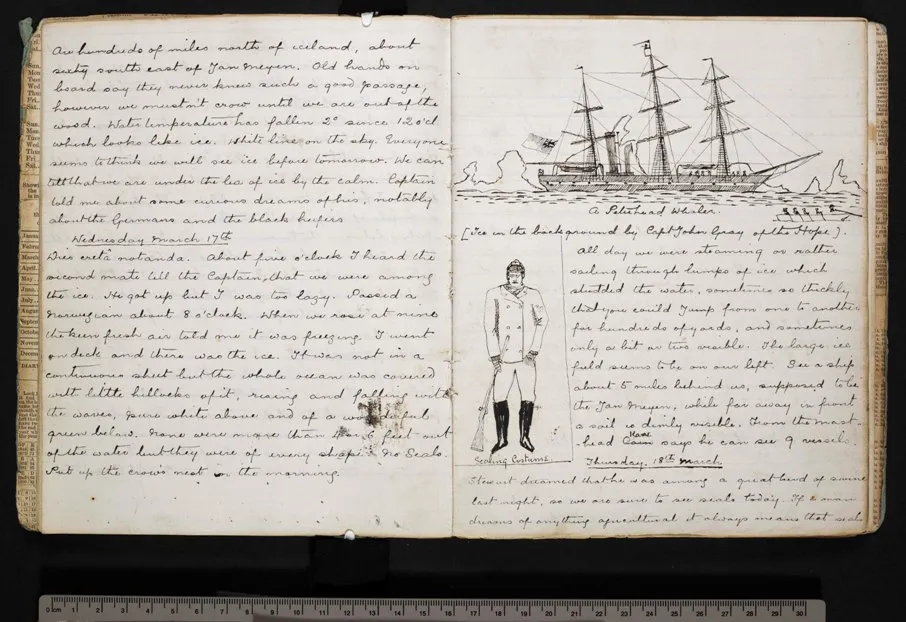
The surgeon aboard the whaling vessel Hope was often covered in the blood of seals and other animals, his clothes frozen enough that he'd have to stand next to the ship's stove to thaw before undressing.
A first-time sailor, he wasn't supposed to take part in the clubbing of seals, but he did, and repeatedly fell into the frigid waters, nearly freezing to death.
A journal by the young man, written at age 20 in 1880, was published yesterday. The author? Sir Arthur Conan Doyle.
Best known for creating the ingenious detective Sherlock Holmes, Doyle was first a surgeon, and went along on the whaling ship after a friend of his backed out, according to a review of the book by the Daily Mail.
The journey was intense and bloody, and the sailors' job was to take as many seals and whales as possible. As noted by the Smithsonian, though, Doyle's journal of the trip isn't all blood and gore, and contains Doyle's neat prose and lovely illustrations of the ship and the terrain it explored in the Arctic Ocean.
The killing of whales was common at the time, although Doyle did write about his feelings of sympathy for the hunted animals. He also describes the beauty of the icy landscape and awe he felt upon seeing enormous humpback whales, which the sailors didn't hunt because they contained too little oil to make their capture worthwhile. Whale oil was valuable for its use in lamps, candle wax and other applications.
Doyle wrote about his experience in both fiction and nonfiction, which helped him first catch the eye of publishers. Although he completed medical school and briefly practiced as a surgeon, he soon realized his true talent lay in writing.
Get the world’s most fascinating discoveries delivered straight to your inbox.
The account of his Arctic voyage is called "Dangerous Work: Diary of an Arctic Adventure" (British Library Publishing, 2012) and is available from the British Library Shop.
Reach Douglas Main at [email protected]. Follow him on Twitter @Douglas_Main. Follow OurAmazingPlanet on Twitter @OAPlanet. We're also on Facebook and Google+.
