













The Preschool Laboratory: Young Children Think Like Scientists

Scientists analyze statistical patterns in data, they do experiments, and they learn from other scientists.
Growing research indicates that young children learn about the world around them in similar ways, writes Alison Gopnick, who studies childhood learning and development at the University of California at Berkeley.
Unlike scientists, preschool-age children don't understand statistics, they don't design their experiments, and they don't attend conferences. But experiments are showing that children can, for example, unconsciously grasp statistical patterns and use this information to solve problems.
In a podcast released by the journal Science, in which her review article appears, Gopnick describes a simple experiment done in her own lab, using a machine that lights up and plays music when certain objects are placed on it. Experimenters show children as young as 2 that, when placed on the machine, one of the blocks activated the lights and music two out of three times. A second block activated it two out of six times. The children are then asked to make the machine go.
"They have seen the machine go off two times in both cases, but if they are actually calculating the probability of the machine going off, they should prefer the two-out-of-three block to the two-out-of-six block," she said.
And this is what four and 2-year-olds did.
"That's a case where even 2-, 3-, 4-year-olds, who are just able to add and subtract seem to be unconsciously able to calculate these probabilities," Gopnick said. Other experiments have shown children can calculate much more complicated probabilities to draw more complicated conclusions, she added.
Get the world’s most fascinating discoveries delivered straight to your inbox.
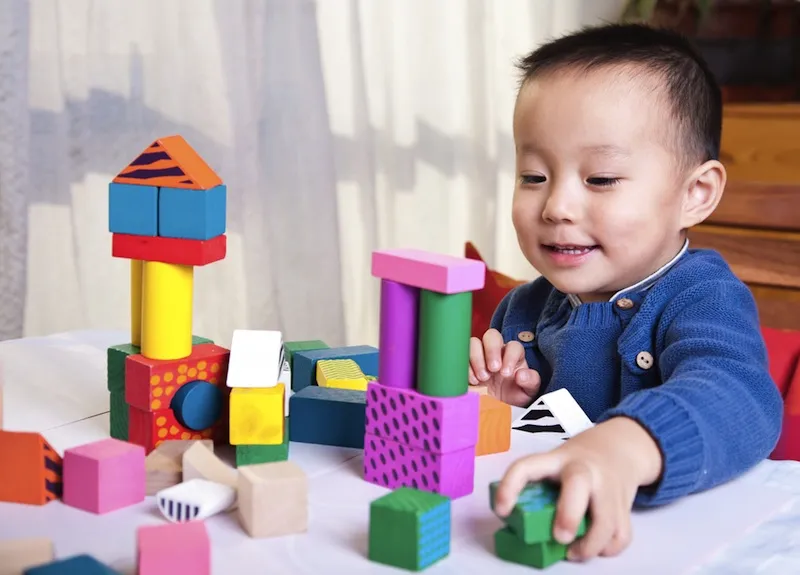
Another line of research done by others indicates that play is actually experimentation. [Top 5 Benefits of Play]
"What these experiments show if you give the children one of these causal problems like figuring out how the machine works and then just leave the video recorder running, what you see is when the child[ren] are just spontaneously playing. … What they do is to do a bunch of experiments that will give them just information they need to figure out how the toy works," Gopnick said.
Young children can also learn about causal relationships by observing the actions of others and their consequences. Teachers and other mentors can also teach tots about cause and effect.
Being shown how to do something has advantages, for both young children and for scientists, as well as disadvantages. Most importantly, being taught something instead of exploring it for oneself discourages exploration that can lead to new conclusions, and research indicates this is the case for young children, Gopnick said.
Gopnick's findings have implications for preschool education, since there is pressure to make the early years more academic with a focus on skills such as reading and math.
"I think what this new research shows is children have amazing cognitive skills when they are 2, 3 and 4," she said. "And they are exercising those cognitive skills in the course of playing, of experimenting, of exploring, and when we make preschool more academic, more structured, more like school, we actually are not encouraging children to do the real deep scientific and cognitive work they are capable of doing."
The research is detailed in the Sept. 28 issue of the journal Science.
Follow LiveScience on Twitter @livescience. We're also on Facebook & Google+.
