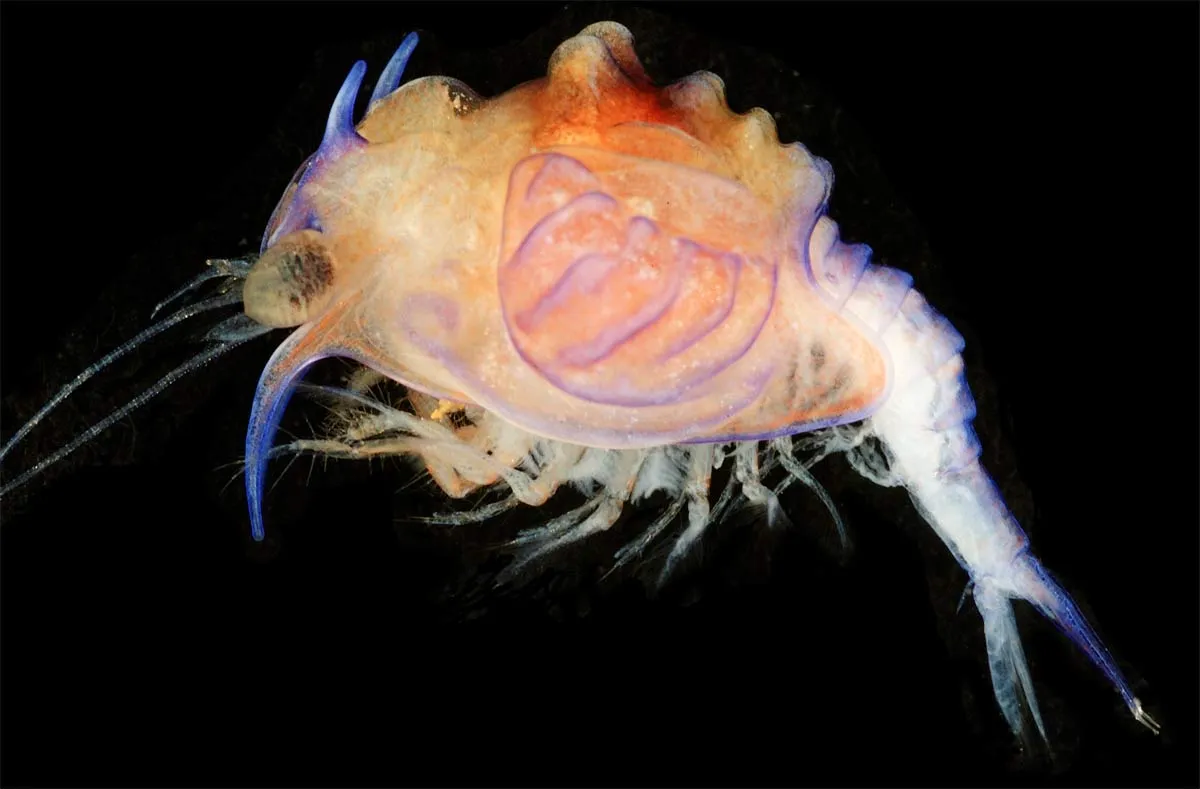
For more than 180 years, scientists had pulled these "monster" larvae from the guts of fish, wondering they looked like as grown-ups. Turns out, they are the baby version of a deep-sea shrimp. [More amazing shrimp photos]
For nearly two centuries, scientists have pulled so-called "monster larva" from the guts of fish and wondered what these thick-bodied creatures looked like as grown-ups. Now one biologist believes he has finally matched the larva with its adult counterpart.
"It's very exciting to have solved a nearly 200-year-old conundrum," Keith Crandall, a biology professor at George Washington University, said in a statement.
Drawing from genetic evidence, Crandall reported in the journal Ecology and Evolution this month that the larva, Cerataspis monstrosa, is actually a baby version of the deep-water aristeid shrimp known as Plesiopenaeus armatus.
Making this match-up between the baby and adult forms was not as easy as finding a larger version of the larva. In fact, the two couldn't look more different, the researchers said. C. monstrosa has a thick body covered in armor with "exceptional horn ornamentation," the researchers write. Yellowfin and blackfin tuna and dolphins prefer this "monstrous and misshapen animal," as the larva was called, for prey — and it was in these predators' gut contents that scientists had encountered the monster larvae.
The larva Cerataspis monstrosa (left) is the baby version of the shrimp Plesiopenaeus armatus (right), researchers reported Aug. 27, 2012.
Scientists began to suspect a link between the two in the 19th century.
"Because previous studies suggested an affinity between Cerataspis and penaeoid shrimp, and more specifically the family Aristeidae, we sampled heavily within these groups," Crandall explained. His lab had been collecting crustacean DNA information for several years, providing a database to compare the Cerataspis DNA and make the link. They found a 99.96 percent match between the sequences of five genes for both organisms.
Sign up for the Live Science daily newsletter now
Get the world’s most fascinating discoveries delivered straight to your inbox.
For the science geek in everyone, Live Science offers a fascinating window into the natural and technological world, delivering comprehensive and compelling news and analysis on everything from dinosaur discoveries, archaeological finds and amazing animals to health, innovation and wearable technology. We aim to empower and inspire our readers with the tools needed to understand the world and appreciate its everyday awe.