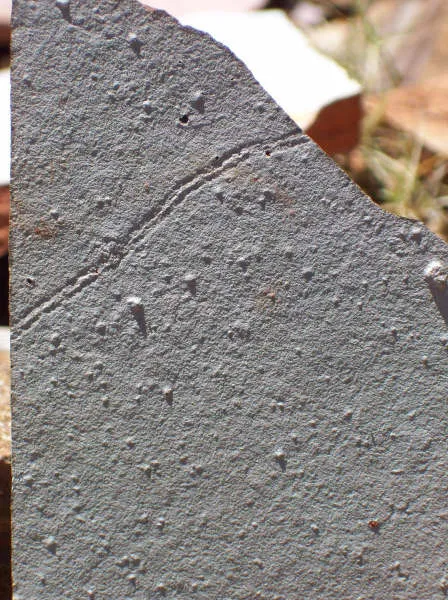
A teensy sluglike animal that wriggled around the sediment in search of food at least 585 million years ago didn't die in vain. The tiny mover left behind tracks that researchers now say represent evidence of the earliest known bilateral animal, or multicellular life with bilateral symmetry.
The finding, detailed in the June 29 issue of the journal Science, pushes back the date for the existence of advanced multicellular animal life by at least 30 million years. The oldest evidence before this discovery came from Russia and dated to 555 million years ago.
Geologists Ernesto Pecoits and Natalie Aubet of the University of Alberta in Canada were studying the rocks at a site in Uruguay in 2007 when they discovered the tracks. They saw that the tracks had been made by a bilaterian, or an animal with bilateral symmetry, with a front and back as well as a top and bottom, unlike corals and sponges. (Tiny sea sponges date back at least 635 million years.)
"But at that point we didn't realize the importance of this discovery, because we didn't know the age of these rocks," Pecoits told LiveScience.
The animal would have been about 0.2 to 0.3 inches (4-7 millimeters) long and 0.04 to 0.08 inches (1-2 mm) wide. Tiny features of the tracks, which were about 0.8 inches (2 centimeters) long, suggest the soft-bodied creature used its musculature and leglike appendages to move along the sediment just below a thin layer of organic matter. The animal was so primitive that it could move only parallel to the sediment and not downward, Pecoits said. [See Photos of the Animal Tracks]
Ernesto Pecoits looks at the layers of rock in Uruguay where the tiny tracks of the earliest multicellular animal were discovered.
(Image credit: Natalie Aubet)
"When you observe [these tracks] you can see like a furrow and on the side you can see ridges and that's because the organism was pushing the sediment out, and sometimes you see the organism goes up to breathe oxygen and then goes down again," Pecoits said.
The researchers looked at two types of material to narrow down the possible age of the animals: intruding lava and tiny minerals embedded in the rocks where the tracks were found. The lava would have intruded into sediment that was already there, suggesting the time of the intrusion would be more recent than the rocks (and the tracks in these rocks).
Sign up for the Live Science daily newsletter now
Get the world’s most fascinating discoveries delivered straight to your inbox.
And then they dated the rocks themselves by analyzing tiny minerals embedded in them. "The maximum age was 600 million, which is saying the tracks were formed between 600 and 585 million years ago, the age of the intrusion," Aubet told LiveScience.
The finding is sure to be met with some skepticism, the researchers said. That's how the scientific method works. Even so, Pecoits said, "the community is going to be pretty excited," adding that he thinks they put solid constraints on the ages of these tracks.
Jeanna Bryner is managing editor of Scientific American. Previously she was editor in chief of Live Science and, prior to that, an editor at Scholastic's Science World magazine. Bryner has an English degree from Salisbury University, a master's degree in biogeochemistry and environmental sciences from the University of Maryland and a graduate science journalism degree from New York University. She has worked as a biologist in Florida, where she monitored wetlands and did field surveys for endangered species, including the gorgeous Florida Scrub Jay. She also received an ocean sciences journalism fellowship from the Woods Hole Oceanographic Institution. She is a firm believer that science is for everyone and that just about everything can be viewed through the lens of science.