













Ancient Ichthyosaur Mother Did Not Explode, Scientists Say

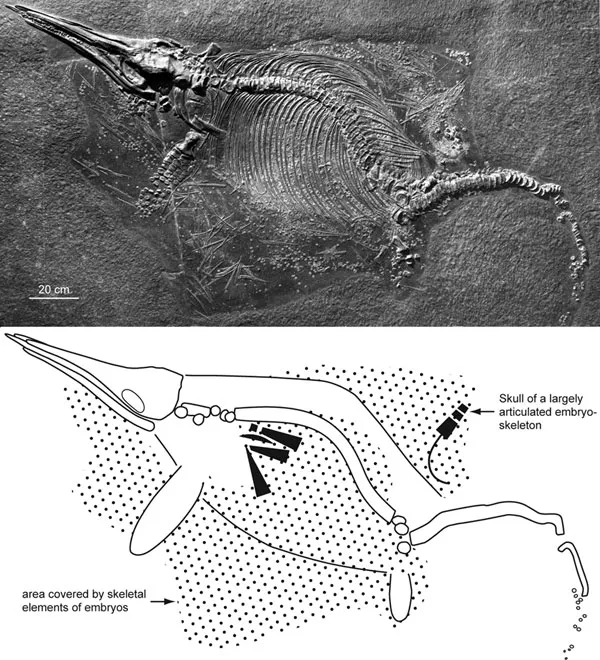
It is unlikely that the body of a mother ichthyosaur exploded, say researchers who offer another explanation for the scattered remains of embryos found around her in rock that was once deep underwater.
Rather, the scattering of the embryos was probably caused by minor sea currents after the expectant mother died and her body decayed some 182 million years ago, the researchers propose.
If this scenario sounds confusing, it is important to know that ichthyosaurs, extinct marine reptiles that lived at the same time as the dinosaurs, did not lay eggs but rather carried their young in their bodies until they gave birth. Ichthyosaurs resembled fish but, unlike most fish, breathed air through lungs.
The nearly intact skeleton of the female ichthyosaur in question was found in Holzmaden, Germany. But the remains of most of the approximately 10 embryos were scattered far outside her body it. Other fossilized ichthyosaur remains have been found in similarly strange arrangements, with skeletons usually complete but jumbled to some degree.
A Swiss and German research team set out to examine the idea that after death, such large-lunged marine creatures floated on the surface, with putrefaction gases building up inside them, until the gases escaped, often by bursting. Such explosions would jumble the bones.
The researchers examined the decay and preservation of ichthyosaur skeletons and compared this information with that of modern animals, particularly marine mammals. To get an idea of the amount of pressure that builds up after death during different stages of bloating, they looked at measurements from the abdomens of 100 human corpses.
"Our data and a review of the literature demonstrate that carcasses sink and do not explode (and spread skeletal elements)," the researchers wrote online Feb. 1 in the journal Palaeobiodiversity and Palaeoenvironments.
Get the world’s most fascinating discoveries delivered straight to your inbox.
Generally, carcasses of ichthyosaurs would have sunk to the seafloor and broken down completely. Only under specific circumstances — including in warmer water less than 164 feet (50 meters) deep — would gas inside the body have brought the remains to the surface, said the researchers, led by Achim Reisdorf of the University of Basel in Switzerland. When this happened, the carcass would decompose slowly, scattering bones over a wide area.
Ichthyosaurs' remains stayed neatly in place only under specific conditions, according to the research team: The water pressure had to be great enough to prevent them from floating, scavengers did not pick them over, and strong currents did not disturb them.
The female ichthyosaur died in water about 492 feet (150 m) deep. Decomposition of the body released the embryo skeletons, and minor currents along the seafloor distributed them around her body, the researchers speculate.
You can follow LiveScience senior writer Wynne Parry on Twitter @Wynne_Parry. Follow LiveScience for the latest in science news and discoveries on Twitter @livescience and on Facebook.
