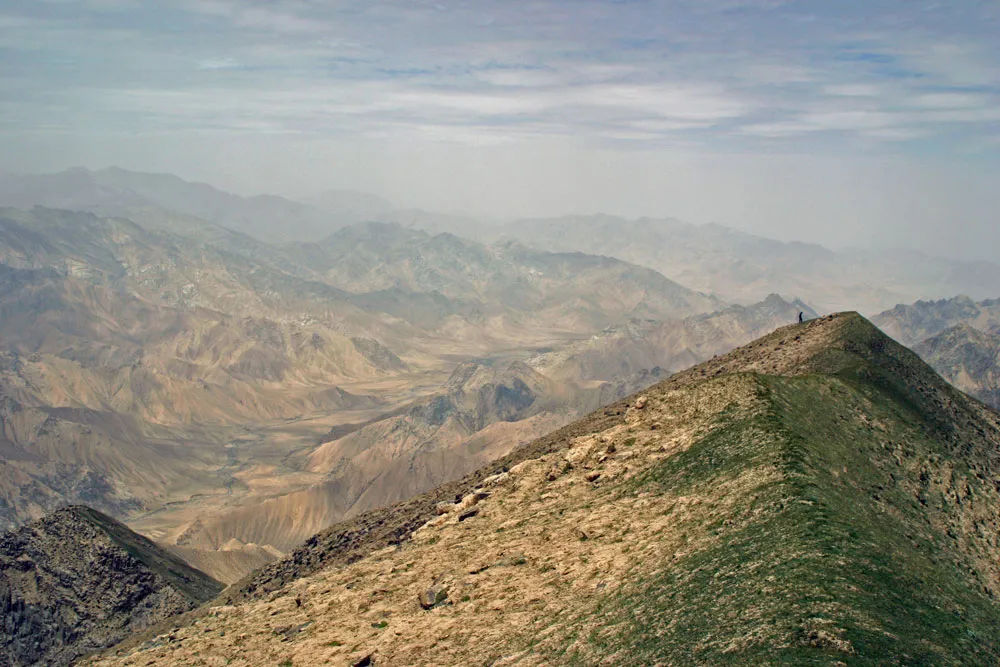
Kunlun Mountains at the northern edge of the Tibetan Plateau. These mountains formed soon after India collided with Asia 50 million years ago despite the fact that the collision was far to the south at this time.
As Earth's tectonic plates move across the planet's surface, the continents that sit atop them are carried along, sometimes smashing together for many millions of years at a time. As the continents mash against each other, their collision gradually slows.
New research suggests that this slowing may be the work of forces not within Earth's crust, as is generally thought, but deep underneath it.
Understanding the forces controlling the shifting tectonic plates can help shed light on the factors that drive earthquakes and volcanoes, as well as the origins and demise of mountains, oceanic trenches and continents.
"The India/Eurasia collision is enormous — it's created the largest landform made in the last 500 million years or so: the Himalaya and the Tibetan Plateautogether," said Clark, a geophysicist and geomorphologist at the University of Michigan, Ann Arbor. "The landform's so big, it affects the atmosphere."
Mountain growth
Clark examined geological data from prior studies to analyze how India has moved northward in the last 67 million years. She also investigated the slowly changing height of the land in the collision region.
Sign up for the Live Science daily newsletter now
Get the world’s most fascinating discoveries delivered straight to your inbox.
"The Himalaya and the Tibetan Plateau have grown as India's moved northward, like how a box would get taller if you squeezed it," Clark told OurAmazingPlanet.
University of Michigan graduate student Alison Duvall measuring rock orientation. These rocks have been folded as a result of continental collision between India and Asia.
(Image credit: Marin Clark)
Clark determined present rates through global positioning system measurements, and established past rates simply by comparing the size of the Tibetan Plateau with the speed at which India moved northward.
Past research suggested that forces within the crust — ones associated with the growth of the Himalaya and the thickening of the crust beneath the Tibetan Plateau — controlled the slowing of the crash between India and Eurasia. However, Clark discovered that the rate of this collision has decreased exponentially since the two began slamming into each other about 45 million to 50 million years ago. In contrast, the rate of mountain growth in the region has apparently stayed relatively constant from the past to the present.
These new findings suggests the slowing of these converging plates is due to a constant amount of resistance starting about 40 miles (60 kilometers) beneath Tibet in the upper portion of the hot mantle layer that, with the crust, forms the rigid outermost layer of the Earth, called the lithosphere.
End of a geologic era
The convergence eventually will halt in 20 million years, Clark estimated, putting an end to one of the longest periods of mountain-building in recent geological history.
The constant stress and strength of the mantle lithosphere produces resistance that can drive tectonic plate motion regardless of how the surface of the Earth crinkles. Still, it could be that forces in the crust play a major role in other continent collisions, Clark said. She is now analyzing the collision between the Arabian, Indian and Eurasian plates occurring in Iran.
Clark details her findings in the March 1 issue of the journal Nature.
This story was provided by OurAmazingPlanet, a sister site to LiveScience.
Charles Q. Choi is a contributing writer for Live Science and Space.com. He covers all things human origins and astronomy as well as physics, animals and general science topics. Charles has a Master of Arts degree from the University of Missouri-Columbia, School of Journalism and a Bachelor of Arts degree from the University of South Florida. Charles has visited every continent on Earth, drinking rancid yak butter tea in Lhasa, snorkeling with sea lions in the Galapagos and even climbing an iceberg in Antarctica.