













2 Skulls Help Unlock Secrets to Ancient Big Bears

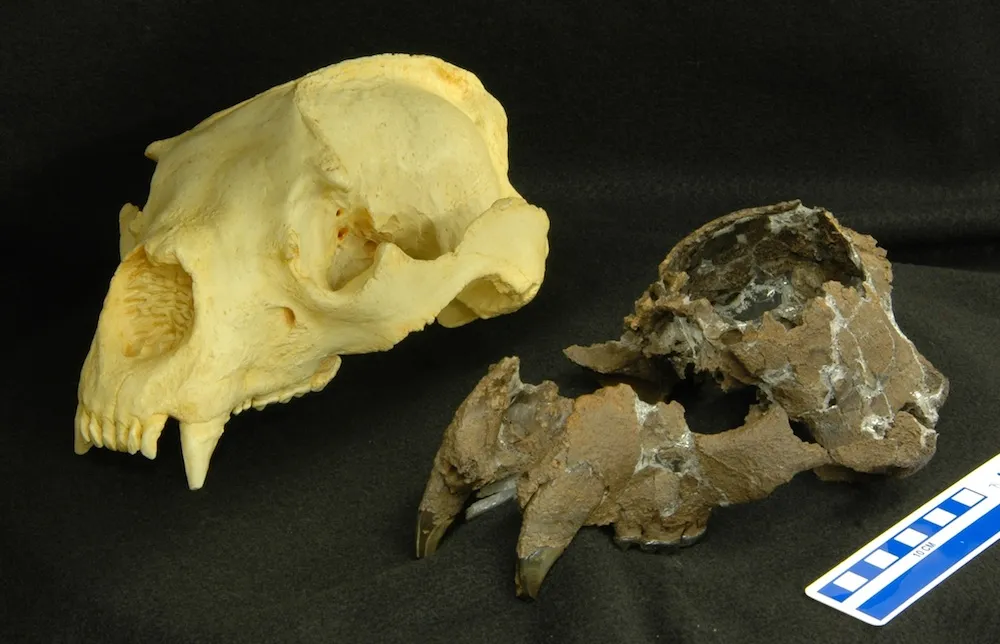
GRAY, Tenn. — Two partial skulls of an ancient short-faced bear species, a potential ancestor to the biggest bears that ever lived, have been discovered in northeastern Tennessee.
The finds represent additional evidence of Plionarctos, a type of bear that went extinct about 3 million years ago, at the Gray Fossil Site in Gray, Tenn. The earlier discoveries consisted of only a small chunk of lower jaw with teeth, and an isolated tooth of a separate individual. The new discovery is most of the skull of an older adult and a portion of an upper jaw of a relatively young bear of the same species.
"The skull was pretty mashed up," Shawn Haugrud, a preparator at the site, told LiveScience. Haugrud did the painstaking work to glue the crushed skull back together again. [Image Gallery: Beastly Bears]
"This represents, by far, the most complete skull of Plionarctos ever discovered," said Blaine Schubert, director of the Center of Excellence in paleontology and faculty member in the department of geosciences at East Tennessee State University. "This is a remarkable discovery. For the first time, we will be able to study the cranial anatomy of Plionarctos, compare it to other bears, and better understand how short-faced bears changed through time."
An illustrious family
The bear was relatively small, about the size of, or even smaller than, today's spectacled bears, which weigh between 130 and 400 pounds (nearly 60 and 181 kilograms) for females and males, respectively. The spectacled bear happens to be the closest living relative to the ancient short-faced bears, and the only surviving member of the short-faced bear's subfamily, Tremarctinae. The lineage boasts some hard-hitters, as well. During the Ice Age, for example, giant short-faced bears that weighed up to 1,800 pounds (816 kg) roamed North America. In South America, a larger species called Arctotherium angustidens reached the record size of over 3,000 pounds (1,360 kg), making it the largest bear ever known.
"What we have at Gray is a potential ancestor to the largest bears that ever lived," Schubert told LiveScience.
Get the world’s most fascinating discoveries delivered straight to your inbox.
The Gray Fossil site, discovered during highway construction in 2000, was a forested lake that filled a sinkhole 4.5 million to 7 million years ago during the Miocene Epoch. Animals who wandered into this lake didn't always make it out, and their bones — tens of thousands of them — were preserved.
The first short-faced bear jaw fragments turned up in 2003, but it wasn't until Gray Fossil Site preparator Jeff Supplee was putting a plaster jacket on a tapir skeleton in 2011 in preparation for removing it from the ground that the skull turned up.
"I saw a big canine [tooth] and realized, 'uh-oh,'" Supplee told LiveScience.
Schubert and his colleagues announced the discovery in December and plan to submit a full description of the Gray Fossil Site bear material to a scientific journal this year.
You can follow LiveScience senior writer Stephanie Pappas on Twitter @sipappas.Follow LiveScience for the latest in science news and discoveries on Twitter @livescience and on Facebook.

Stephanie Pappas is a contributing writer for Live Science, covering topics ranging from geoscience to archaeology to the human brain and behavior. She was previously a senior writer for Live Science but is now a freelancer based in Denver, Colorado, and regularly contributes to Scientific American and The Monitor, the monthly magazine of the American Psychological Association. Stephanie received a bachelor's degree in psychology from the University of South Carolina and a graduate certificate in science communication from the University of California, Santa Cruz.