













Lucy on Tour: See Evolution's Biggest Bones of Contention
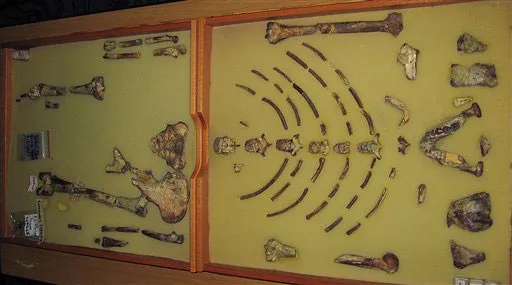
Human fossils look like a bunch of dusty old bones to most people, but to paleoanthropologists, scholars who piece together our ancient past, they are more beautiful than diamonds. Human fossils also used to be as rare as diamonds, but in my scholarly lifetime, the stash of human fossils has grown from a tiny pile to a plethora. There are plenty of skulls and teeth from just about every period of our nearly 5 million-year history as hominids, but the most exciting finds are the full skeletons. When there are arms, legs, a pelvis and some ribs, it's possible to reconstruct the whole person. The crown jewel of these ancient full skeletons is Lucy, a woman found in the barren Afar region of Ethiopia in 1974 by Donald Johanson and his team. Officially called an Australopithecus afarensis, Lucy lived 3.2 million years ago, was three and a half feet tall (rather short for her kind) and walked like we do. But she had a brain the size of a chimpanzee and probably spent time swinging through the trees as her curved hand bones indicate. Lucy is the quintessential combination of human and ape, and she changed the way we draw the path of human evolution. And now Lucy is coming to a museum near you. The Ethiopian government is sending a major show of fossils on tour around the United States, with Lucy as the star. She will land in Houston, Texas, and then hit 10 other cities over several years. The announcement of this tour has sparked controversy in the museum and academic communities. Some feel Lucy is too fragile to travel. Others feel she is too sacred to be on display. But the nay-sayers tend to be scientists who've had a good look at her anyway. For the rest of us, this is a chance of a lifetime, more significant than viewing King Tut's mask, and more amazing than the Hope Diamond. In fact, a viewing of Lucy will spark public interest in human evolution, and that's good for everybody, scientists and the general public alike. Truth is, this is not the first time important human fossils have come to the United States. In 1984, the American Museum of Natural History gathered original human fossils from all over the world for their "Ancestors" exhibition. For those with an interest or obsession with the human past, getting a look at the real stuff was a profound experience. But Lucy was not in attendance. Her current tour is our chance to see the little woman who changed human history. I, for one, will be happy to stand in line. Meredith F. Small is an anthropologist at Cornell University. She is also the author of "Our Babies, Ourselves; How Biology and Culture Shape the Way We Parent" (link) and "The Culture of Our Discontent; Beyond the Medical Model of Mental Illness" (link). Editor's Note: Tour details according to the Associated Press--Lucy debuts on Aug. 31, 2007, at the Houston Museum of Natural Science. The exhibition runs through April 20, 2008. Lucy also will be on exhibit at the Field Museum in Chicago from November 2009 through April 2010. The Denver Museum of Nature and Science also is tentatively set to exhibit Lucy.
- Top 10 Missing Links
- Top 10 Intelligent Designs
- All About Evolution
Get the world’s most fascinating discoveries delivered straight to your inbox.