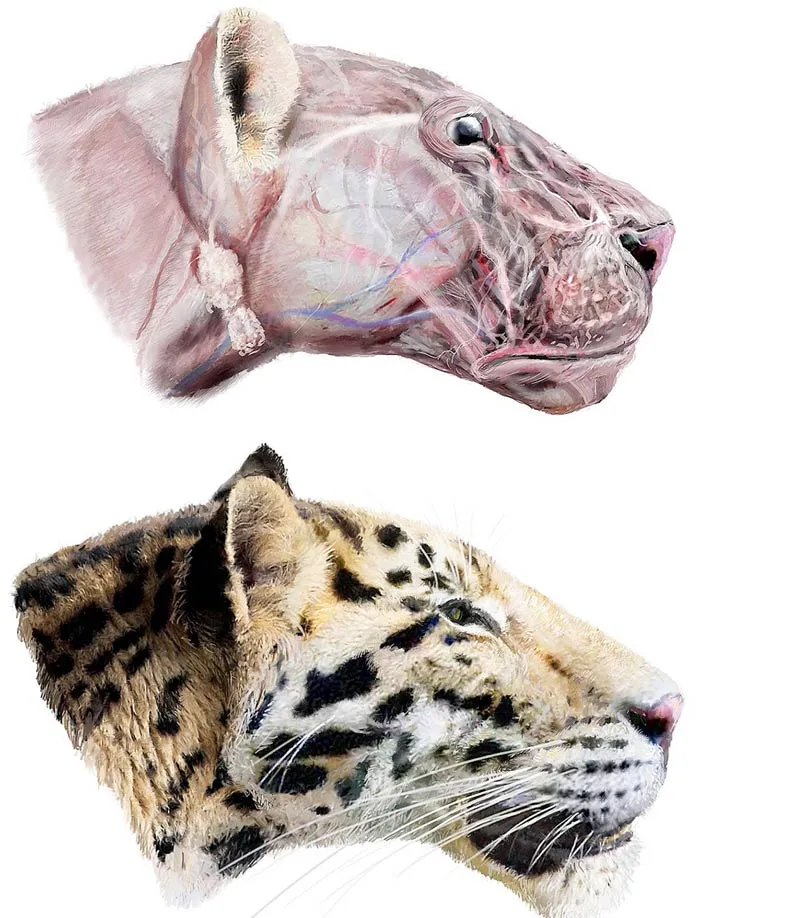
The extinct Longdan tiger (Panthera zdanskyi) was a jaguar-sized tiger that lived in what is now northwestern China more than 2 million years ago. Shown here, an artist's reconstruction of the tiger.
(Image credit: Velizar Simeonovski et al, PLoS ONE)
The oldest extinct species of tiger known yet has been discovered in China, scientists say.
Although the skull of the more than 2-million-year-old fossil is smaller than most modern tigers, it appears very similar in shape, researchers added.
The tiger (Panthera tigris) is one of the largest living cats, a giant predator native to Asia reaching up to 13 feet (4 meters) in length, including its tail, and weighing up to 660 pounds (300 kilograms). The beast's origins are under intense debate, with suggestions it arose in north-central China, southern China or northern Siberia.
Now scientists have discovered a new skull and jaw from an extinct jaguar-sized tiger in northwestern China dating back 2.16 million to 2.55 million years, predating other known tiger fossils by up to a half-million years. This represents the oldest complete skull hitherto found of a pantherine cat — the lineage that includes tigers and all other living big cats.
The skull of this extinct cat had robust, well-developed upper canine fangs and a relatively long nose, details typical of tigers.
(Image credit: J.H. Mazak et al, PLoS ONE)
"The discovery of the identity of this fossil is vitally important for providing a greater understanding of the fossil history of big cats and the relationships between them," said researcher Andrew Kitchener, principal curator of vertebrate biology at National Museums Scotland in Edinburgh.
The scientific name for this newfound species is Panthera zdanskyi, after the late Austrian paleontologist Otto Zdansky, who revealed much about ancient Chinese fossil carnivores. It was unearthed in 2004 on the eastern slope of Longdan, a village in Gansu, China, giving it the informal name of the Longdan tiger. The cat was only recently analyzed and described online Oct. 10 in the journal PLoS ONE. [Gallery: 9 Subspecies of Tigers]
The skull of this extinct cat had robust, well-developed upper canine fangs and a relatively long nose, details typical of tigers. Although the size of the skull is comparable with that of the smallest females of living tiger subspecies, its overall shape suggests it belonged to a male. Indeed, despite about 2 million years of separation, the skull of the Longdan tiger appears surprisingly similar to that of modern tigers.
Sign up for the Live Science daily newsletter now
Get the world’s most fascinating discoveries delivered straight to your inbox.
"It seems likely that this tiger's diet would have been similar to that of today's and would have included ungulates such as deer and pigs,"Kitchener told LiveScience.
The researchers suggest this extinct cat was a sister species to the modern tiger. Their analysis argues that the tiger lineage developed features of its skull and upper teeth early on, while its lower jaw and teeth evolved at a different rate. A similar pattern of "mosaic evolution" is seen in the cheetah lineage, they noted. The evolutionary trend of increasing size in the tiger lineage is likely coupled its prey evolving larger body sizes, the researchers added.
"It will be interesting to see whether further fossil big cats are discovered in China and elsewhere, which expand our knowledge of the distribution of this species and fill in more gaps in the tiger's fossil history," Kitchenersaid. "Confirming a more precise dating of Panthera zdanskyi would also be invaluable for understanding its position in the tiger's evolutionary timescale."
Follow LiveScience for the latest in science news and discoveries on Twitter @livescience and on Facebook.
Charles Q. Choi is a contributing writer for Live Science and Space.com. He covers all things human origins and astronomy as well as physics, animals and general science topics. Charles has a Master of Arts degree from the University of Missouri-Columbia, School of Journalism and a Bachelor of Arts degree from the University of South Florida. Charles has visited every continent on Earth, drinking rancid yak butter tea in Lhasa, snorkeling with sea lions in the Galapagos and even climbing an iceberg in Antarctica.